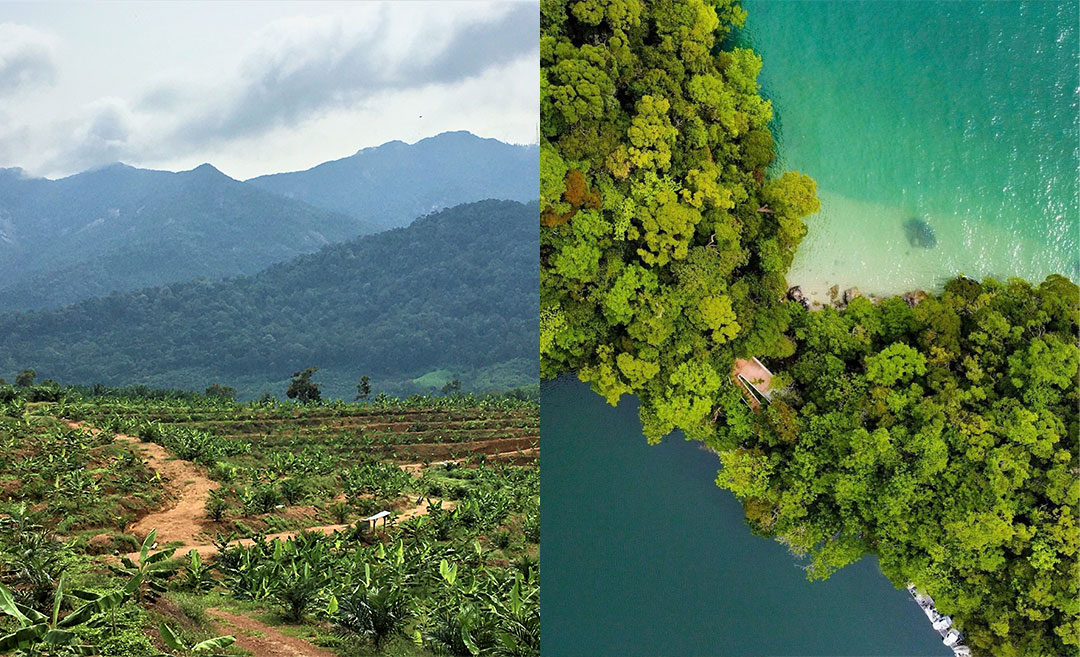
From lakes and mountains to historic landmarks, some of Malaysia’s most fascinating destinations are connected to women from local legends and folklore whose stories have been passed down through generations. (Left image by Slleong; Right image by @dayangbuntingofficial)
Part of the lure of Malaysian destinations lies in the stories and folklore connected to these attractions. Many of these legends and stories have been passed down through generations by word of mouth, while some are even recorded in the Sejarah Melayu (Malay Annals).
Here are six Malaysian destinations linked to women from local legends and folklore, where stories of love, sacrifice, and mystery continue to shape how we experience these places today.
Tasik Dayang Bunting, Langkawi
When translated, the name of this freshwater lake means ‘Lake of the Pregnant Maiden’. According to one version of the folklore, a man named Mat Teja and the fairy princess Mambang Sari fell in love, married, and had a son.
Their son, however, did not live long. The couple laid their son to rest in the lake, and according to local belief, the princess blessed the lake so that women who bathed in it would be blessed with fertility.
To add to the mystery of this story, the hills surrounding the lake resemble a woman lying down on her back with a pregnant belly. The lake is also unusual because it is not salty, even though it lies close to the sea and is separated from it by a thin strip of land.
Gunung Ledang, Johor
Many versions of the folklore surrounding the fairy princess are said to have lived on this mountain – her name was Puteri Gunung Ledang. Sultan Mansur Shah, the sixth Sultan of Melaka, heard of the princess’ beauty and wanted to marry her.
Upon hearing of the Sultan’s intention, the princess set seven impossible conditions for him to fulfil if he wished to have her hand in marriage.
A golden walkway from Melaka to the mountain.
A silver walkway from the mountain to Melaka.
Seven barrels of tears.
Seven barrels of young betel nut juices from the betel tree for her to bathe in.
Seven trays filled with the hearts of germs (or microbes, depending on the version of the legend).
Seven trays filled with the hearts of mosquitoes.
A bowl of the blood of the Sultan’s young son and gold.
The Sultan could not fulfil the final request, requiring him to kill his only son. The legend is often interpreted as a reminder of the Sultan’s pride, with the princess’ impossible conditions serving as a way to reject his proposal.
Some versions of the legend say that the gold and silver bridges disappeared into the forest or remain hidden in the spirit world.
Hang Li Poh’s Well, Melaka
According to the Sejarah Melayu, Hang Li Poh was a Chinese princess sent to Melaka to marry Sultan Mansur Shah, although historians continue to debate the historical evidence surrounding her existence, as Chinese records do not confirm the marriage. It also records that the Sultan built a palace for Hang Li Poh and her attendants, giving them a permanent home at Bukit Cina.
The Hang Li Poh Well was built by the followers of the princess and served as an important water source for the surrounding community. It is considered one of Malaysia’s oldest surviving wells, and local stories say that it never dried up.
Makam Mahsuri, Langkawi
Makam Mahsuri, also known as Mahsuri’s Tomb and Cultural Centre, commemorates the legendary Mahsuri, who is remembered in local folklore as one of Langkawi’s most beautiful women. According to legend, she was born in Langkawi after her Thai parents migrated from Phuket in the 18th century.
While there are many versions of the story, Mahsuri was said to be so beautiful that even the married village chief wished to marry her. Mahsuri eventually married a warrior, but the Siamese invasion of Kedah broke out soon after, and her husband left to join the fighting.
According to the legend, Mahsuri was falsely accused of adultery out of jealousy and sentenced to death. Repeated attempts to execute her with different weapons proved futile, until Mahsuri offered to be stabbed with her father’s keris — a traditional Malay dagger. White blood was said to have flowed from the wound, which was believed to prove her innocence.
Mount Santubong and Mount Sejinjang, Sarawak
According to folklore, Puteri Santubong and Puteri Sejinjang were two princesses sent down from heaven to stop a war between two local villages. However, the gods gave them one condition — they were not to quarrel with one another.
Princess Santubong was skilled in embroidery and weaving, while Princess Sejinjang excelled at farming and harvesting. With their skills, they brought peace and wealth to the village. However, both princesses eventually fell in love with Prince Serapi, setting the stage for a rivalry that broke the gods’ only rule.
The gods were angered and transformed the two princesses into mountains. Locals say Mount Santubong resembles a woman lying on the ground, while another version of the legend links the three islands surrounding Mount Sejinjang to the princess’ shattered face after the sisters’ final quarrel.
Naga Bari Lake, Sarawak
According to Iban oral tradition, this lake is home to a benevolent spirit known as Naga Bari, a mythical princess believed to help those seeking blessings, particularly couples hoping to conceive. Legend says she descended from the heavens to bathe in the lake despite her father’s warning not to interfere with the lives of mortals. One day, however, she saw a man drowning and rushed to save him.
When the princess fell in love with the mortal, her father transformed the man into a dragon and forbade her from ever returning to heaven. She begged for her father to reconsider, and he eventually concluded that the princess had to fulfil the wishes of all mortals that came to the lake for her to one day return to heaven.
The local Iban community believes they can seek the princess’ blessings through a traditional offering ritual known as miring. The lake has never dried up even through droughts, with some people claiming to have seen the princess bathing there in the early mornings.
Behind every mountain, lake, and landmark is a story waiting to be retold. Whether you believe the legends or simply enjoy the folklore, these places offer another way to experience Malaysia — one that’s shaped as much by imagination as it is by history.