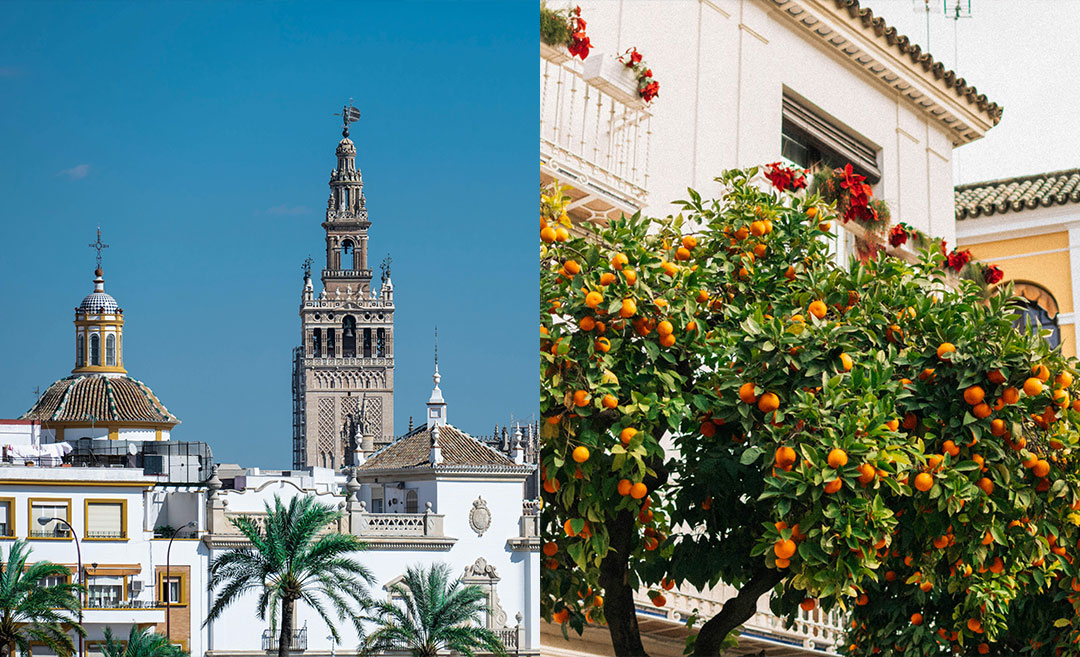
Roam Seville’s Moorish palaces and orange-tree-lined streets, eat quite possibly the best tapas ever, and discover why this city lives up to the hype. (Left image by José Maldonado Díaz. Right image by Pille R. Priske.)
The author is writing a series of articles under the theme ‘Exploring Spanish Culture, Cuisine, and Character’, as she makes her way through Spain. This article is the fourth part in the series, focusing on Seville. Find the other parts of the series here: Madrid, Barcelona, Granada.
There’s something about Seville that burrows right under your skin and nuzzles your heart. I don’t know if it’s how the city feels, it’s straight out of a film set (which is, understandably, why some of the most iconic and beloved movies have been shot here), or it’s the fact that it’s the birthplace of flamenco. But I absolutely get why everyone who visits falls head over heels. The following stuck with me long after I left—
Golden hour at Seville’s Plaza de España
I’m not exaggerating when I say that Seville’s Plaza de España is one of the most beautiful plazas I have ever seen in my life. It is grand. It is regal. It is full of life and detail and tiles that’ll make you look twice. Every little corner is a picture-perfect amalgamation of architectural elements. Now combine this with golden hour, and you’ve got yourself a recipe for a near-spiritual experience, whiplash, and a full camera roll.
If you’re in the area before sunset, the romantic Parque de Maria Luisa is right by the plaza, and is Seville’s most famous park. It used to be the private gardens of the San Telmo palace until it was donated to the city in 1893 and given new life by French engineer Jean-Claude Nicolas Forestier, who was inspired by the gardens of the Generalife, Alhambra, and Alcázares.
Orange trees. Orange trees everywhere.
With about 50,000 orange trees lining its little calles (streets) and plazas (squares), it’s pretty clear why Seville has a rep. In fact, it has more orange trees than any other city in the world! I was there in October, so I didn’t get to see orange blossoms (spring) or full-frontal fruiting (winter to early spring), but I can imagine how beautiful those times must be.
I did, however, get to try Seville’s famous vino de naranja, an Andalusian orange wine and regional speciality, at Taberna Álvaro Peregil, which made me feel a little less FOMO about the orange blossom season.
Tip: Barrio Santa Cruz, Seville’s old Jewish quarter, is an area brimming with these orange-tree-lined calles and plazas I speak of.
Walking along Canal de Alfonso XIII
This isn’t exactly on Seville’s main tourist path, which is exactly why I loved it so much. I started by crossing at Triana Bridge (aka Puente de Isabel II), into Barrio de Triana, and walked along Calle Betis down to Plaza de Cuba to check out one of the city’s icons—Torre del Oro.
Triana is a vibrant little neighbourhood that has a stronghold on the pottery and tile industry, so it should come as no surprise that this is where you’ll find buildings and quaint eateries (e.g. Alfarería 21) covered in colourful ceramic tiles.
Palaces, galleries, and museums galore
For a relatively small city, Seville is chock full of stunning palaces, galleries, and museums. Here’s what I mean…
Royal Alcázar of Seville
(Tip: Book tickets in advance!)
Casa de Pilatos
Palacio de las Dueñas
Palace of the Countess of Lebrija
Setas de Sevilla
Antiquarium
Seville Museum of Fine Arts
Centro Andaluz de Arte Contemporáneo
Late-night tapas, live music, and flamenco
On one of the nights, I felt like listening to some live music and found a jazz club called Gallo Rojo. It was a jam night, with different artists rotating throughout the evening, and it seemed very much like a local hangout spot, which is an experience I don’t regret. However, I would say the drinks were pricey, with an added surcharge per drink ‘for the performers,’ and then the performers would come around with a hat for extra tips. That’s all I have to say about that.
BUT! What came after was honestly the star of the show. I hadn’t had dinner. It was getting late. And as I was walking back to my hostel after some jazz, I stumbled upon Salsamento, a tapas bar that was full except for one seat, which kind of felt like it was meant for me. And, dare I say it? It was the best tapas I’d had my entire trip through Spain. I asked the waiter to surprise me with dishes and pair them with his suggestion of wines, and it was absolutely divine.
And if you’re looking for a flamenco show (as you would, in the birthplace of flamenco), there are a plethora of places that offer performances alongside late-night tapas, like La Carbonería, which is in an old coal warehouse.