Get insightful tips through this traveller’s reflections on the cities she’s lived in and travelled to in South Korea. (Left: Image by @braggworthyadventures. Right: Image by @namiisland_naminara.)
There’s a saying: “If you can survive living in South Korea and not get beaten down by it, you are more than well prepared for anything life throws at you. Nothing is worse than that.” Take it from me—it’s true.
Having travelled and lived there, my perspective and understanding have changed massively over the past decade. From the mental preparation to comprehending laws and regulations, boarding a flight alone, being in genuine danger, and meeting both kind and rude people. In my book, South Korea is both heaven and hell—it can be a lot and not much in between.
In this piece, I will guide you through how and where to travel in South Korea, and what to look out for to ease the process. There are social loopholes and lots of things you need to know and avoid—I will provide a realistic and insightful perspective to give you clarity on what to expect. I hope you create many beautiful memories you can look back in time with warmth and a smile.
Travel tips before you go
Keep in mind that some of these suggested locations are local, lesser-touristed spots. If you decide to visit them, do observe the local mannerisms. South Koreans in general are very particular about things being a certain way. They do not necessarily care for foreigners and can be vague with explanations. That’s not to say you can’t ask for directions or help—it may just mean that they might not care enough to answer or aren’t interested altogether and you are probably better off on your own. Your experience will also be drastically different if you ask for help in Korean.
Having basic knowledge about Seoul culture and being able to adapt quickly where needed is important. Being somewhat well-versed in Korean (plus other languages like English and Chinese) is gold and gets you what you need and where you need to be faster.
Getting around: Google Maps may not be as efficient and accurate as Naver Map. However, do note that Naver Map is completely in Korean and locations entered in English may show the wrong location or a longer route. All locations mentioned in this article include their Korean titles and addresses, simply copy and paste and you should be good to go!
People and culture: Don’t take too much offence if people shove past or yell at you rudely to get out of the way (literally). After years of experiencing it, I personally wouldn’t take it too much to heart. South Koreans are known to be blunt and brutal—yelling in public is a daily occurrence, especially with ajummas (middle-aged women) and ahjussis (middle-aged men). My advice? Go about your day as usual and go on your way—try to not let it affect you too much.
Ordering and speed: Figure out what you want to get before standing in line for food. Ordering in English or Chinese is generally accepted in big cities but this is circumstantial. Efficiency and speed is key in everything, from ordering food to taking the subway. Anything that stands in the way or slows things down should be minimised or eliminated.
Busan 부산
Busan is often described as a peaceful haven—rich in everyday charm and refreshingly down-to-earth. It’s easily one of the chillest cities I’ve travelled to. While it’s not exactly underrated, it’s also not an overkilled commercialize and touristy packed destination. Busan offers a balance of warm, lively, and friendly locals, accompanied by stunning, unpolluted views of the sea, both day and night.
It’s one of my personal favourite cities and will always hold a special place in my heart.
Jagalchi Market 자갈치 시장
Jagalchi Market is one of the first few local seafood markets I’ve been to and it has the largest variety of seafood and food items one can find. If you love seafood (like me) and want to shop and experience the freshest, most affordable seafood, this is hands down a must-visit.
The market is divided into two main sections: (i) Jagalchi Fish Market and (ii) Jagalchi Vegetable/Food Market, and they are both connected over a long pathway. The vast ocean out front is where most of the seafood you consume comes from. Busan prides itself in this well-known seafood market—the local vendors work hard through blood, sweat, and tears, even during winter.
Recommended season to visit: I visited Jagalchi Market at the end of fall and I highly recommend going during fall or winter. The chilly weather adds to the experience of the open-air market. Eating fresh seafood in freezing cold air while gazing out at the ocean is a kind of bliss you have to experience to understand.
Address: 52 Jagalchihaean-ro, Jung-gu, Busan, South Korea (부산광역시 중구 자갈치해안로 52)
Gamcheon Culture Village 감천문화마을
If you are visiting Jagalchi, make your way to Gamcheon too. It is located within walking distance, across from Jagalchi. I would recommend visiting both locations on the same day and making it a day trip: Morning–Jagalchi Market, Noon–Gamcheon Culture Village.
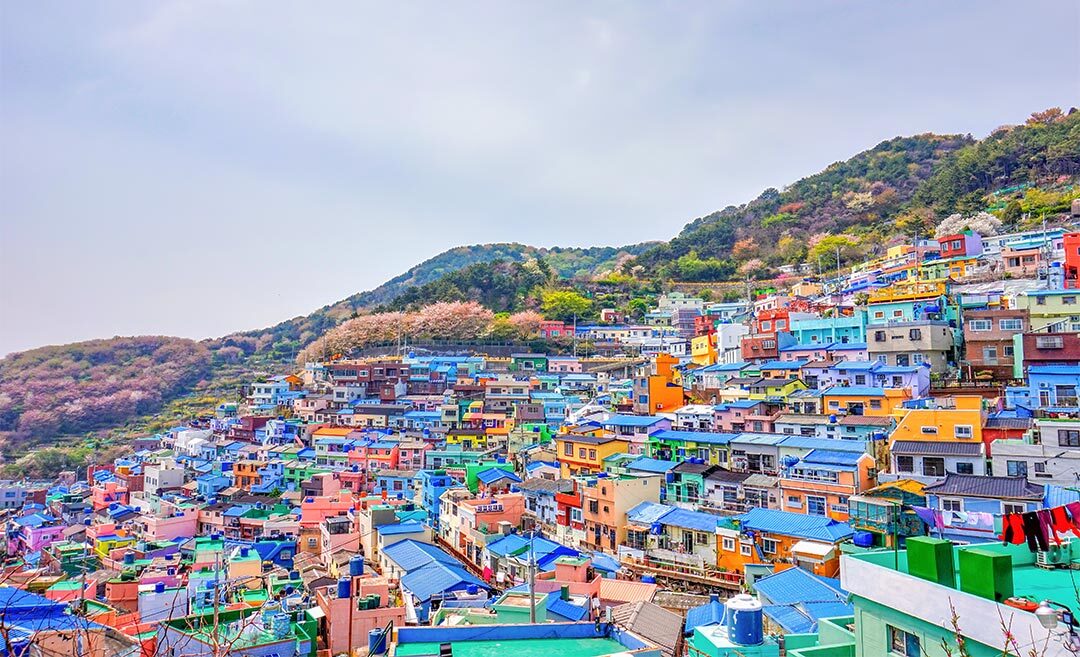
Gamcheon Culture Village is known for its colourful, pastel, village-in-the-clouds-like vibes. Featuring lots of stairs, art installations, and murals. Every building and house displays a different drawing with various meanings behind each piece. Gamcheon is also a popular spot for couples as you get a romantic panorama of the village and the ocean from high vantage points.
If you’d love to explore further, simply walk along Gamcheon’s main street. You’ll see cafés, snack and souvenir shops, and rows of beautiful lights above you. Enjoy a drink or take a breather at the coffee shops and small family restaurants here.
Things to note: As you enter the village, there will be signs urging you to be respectful and quiet (especially on the main street), to not litter, and to pick up after yourselves while visiting. Keep in mind that despite it being a famous heritage spot, Gamcheon is also home to the locals who live there.
Recommended season to visit: Spring and Fall. Visit in the spring if you are comfortable with crowds and prefer warmer temperatures, and in the fall if you don’t mind the cold. Do note that it can be bone-chilling cold in fall—make sure you layer up and check the weather forecast in advance. Gamcheon is generally busy throughout the year.
Address: 203 Gamnae 2-ro, Saha-gu, Busan, South Korea (부산광역시 사하구 감내2로 203)
Gyeonggi-do 경기도
Gyeonggi-do is mostly known for its peaceful gardens and heritage sites. It is the very first province I called home while in South Korea—it is like a second home that holds many of my youthful memories. Gyeonggi-do is extremely Korean-centric, therefore, speaking in Korean would be ideal. You’ll still be able to get by with little to no knowledge of Korean language, but do bear in mind it can be tough.
Jukjeon-dong, Yongin-si & Suwon-si 죽전, 용인시, 수원시
Away from everything fast-paced while still having basic necessities within reach, these three neighbourhoods would only be familiar to locals. Personally, I’ve never experienced serenity and peace like when I lived and studied here.
You will not find many attractions or touristy spots here, but you will be able to observe the real, everyday lives of South Koreans. I’d recommend visiting for a day or two to indulge in local food, visit Everland, take a slow stroll on the streets of Suwon to Jukjeon, and do some people-watching. You’ll be surprised how different life is here and what day-to-day South Korea looks like.
Everland address: 199 Everland-ro, Pogok-eup, Cheoin-gu, Yongin-si, Gyeonggi-do, South Korea (경기도 용인시 처인구 포곡읍 에버랜드로 199)
Recommended season to visit: Fall and Winter. You might catch a glimpse of flaky, snowy skies here earlier than you would in Seoul. Since it’s on a highland, it will be much colder—so make sure you are prepared. Fall is breathtakingly cold yet stunning, with yellow, brown, and red leaves welcoming the season. Best of all, there are no crowds and a lot less people around.
I would not recommend visiting in the summer—it is longer than average and scorching, oven-hot. If you do plan to visit in summer, make sure you are cooling off indoors in between visits to different locations. Otherwise, you can end up with second to third-degree burns or an extremely bad heatstroke. However if you are moving from Malaysia to live here-your best option might be to arrive in the summer and adapt to the cold gradually.
Seoul 서울
South Korea’s captial is no stranger to most travellers. Contrary to popular belief about Seoul’s nightlife, festivals, and luxurious lifestyle, the city actually has a lot of heart and history. Especially in the old parts of town where many older folks and families reside. From quiet alleyways with family restaurants and local marts, to breezy streets and handmade Hanbok tailors—I wholeheartedly believe that Seoul, despite being ripped apart by its many flaws, still has a soul, like its name.
Hongdae Street – Hongik University Station, Exit 8 & 9 홍대 출입구 8 9
Are you curious why exits 8 and 9 specifically? Let me explain. One of the biggest mistakes you can make is going to the wrong exit—knowing which exit to go is crucial! Nine different exits mean nine different worlds at each door. They’re spread out across Hongdae and Sinchon districts and each walk back to another door is at least five minutes.
Exits 8 and 9 are the closest to attractions: exit 8 for buskers, shopping, snack stores and cafés, exit 9 for local cafés, restaurants, bars and nightlife. Beyond the main street, near Hongik University, is where you find will a local gem—where locals and foreigners call home. This is where all the local food trucks, game arcades, restaurants and nightlife are, which are frequented by locals.
Scams & suspicious situations to look out for: Stay away from cult recruiters—they approach you in pairs or groups, being extra friendly and chatting you up. Be aware of people who appear to be under the influence of drugs or alcohol, pickpockets (especially foreigners targetting other tourists), and strangers on the street asking to “practice English” or engage with you by asking random questions. If you feel uncomfortable or don’t know how to respond: simply say no and walk away.
However, it is not uncommon for genuine travellers to ask for directions, especially if you appear local. People tend to be able to tell the difference between a traveller and a foreigner who lives there, so your experience may depend on how you’re perceived. It goes both ways-if you need directions and Korean people are avoiding you, ask another foreigner for help instead!
Bars & clubs: Bars are generally safe. As for clubs, always keep a watchful eye over your drink as spiking is extremely common. Upon every entry, you will be asked to show proof of legal age, so bring along your passport or identification document. Look out for signs that say “외국인 금지” with a big X. This means: foreigners or foreigners who don’t speak Korean are not welcomed or allowed entry.
Living here: Coming from someone who has done this, DO NOT live anywhere near exits 8 and 9. Location is extremely important so do your research on the demographics and noise pollution levels. Explore the neighbourhood beforehand to see if you like it and if it feels safe for foreigners. In my experience, the best houses are the ones on higher ground—there’s usually a staple community garden, and is extremely tranquil with a mixed community of locals and foreigners.
Recommended season to visit: All year round. Each season has its own unique charm on the streets of Hongdae.
Exit 8 address: 166 Yanghwa-ro, Mapo-gu, Seoul, South Korea (near Exit 8) | 서울특별시 마포구 양화로 166 (8 근처)
Exit 9 address: 152 Yanghwa-ro, Mapo-gu, Seoul, South Korea (near Exit 9) | 서울특별시 마포구 양화로 152 (9 근처)
Additional information on Hongik University Station exits: 홍대 1289 출입구 설명안내 (Translated version)
Gyeonggi-do & Gangwon-do 경기도 & 강원도
If being in the city is not your cup of tea, I would recommend a day trip or a short two to three-day getaway. Here’s an outline of the districts and their attractions for your little getaway:
Gangwon-do: Nami Island (강원도: 남이섬)
Gyeonggi-do: The Garden of Morning Calm, Gapyeong Rail Park, Petite France (경기도: 아침고요수목원, 가평레일파크, 쁘띠프랑스)
As you are already in Seoul, it would be convenient to visit the small but popular Nami Island. Nami Island is located in Gangwon-do, just slightly outskirts of Seoul. The dock is easily accessible by the ITX train, subway, or a pre-booked bus ride. You will then need to get a ferry ticket at the dock and board a ship. Ziplining to Nami is also an option if you are looking for an adventurous and unforgettable route (one-way only—going in).
There is only one way in and out of the island, so do pay attention if and when they make announcements to evacuate the island for safety measures (especially during monsoon season).
The 2002 drama series Winter Sonata is famously known to have been filmed on this very island and has held up Nami’s name for over a decade. The island has a rich history despite its fame for many years. This little island’s attraction lies in its natural surroundings, local community, and as a memorial.
Recommended seasons to visit: Spring, Fall, and Winter. While fall is the most popular time to visit for its stunning foliage, each season paints the island’s natural charms in its own enchanting way. However, I would not recommend going during rainy or typhoon season, typically from August to October, as the weather can dampen the experience.
Nami Island address: 1 Namiseom-gil, Namsan-myeon, Chuncheon-si, Gangwon-do, South Korea (강원특별자치도 춘천시 남산면 남이섬길 1)
Extend your day trip by visiting The Garden of Morning Calm, Gapyeong Rail Park, and Petite France in Gyeonggi-do province. Read more here on how to make all these attractions blend seamlessly into a day trip.
The Garden of Morning Calm
Gapyeong Rail Park
Petite France