It’s time to explore Malaysia a little differently—through dark tourism. Discover the secrets and stories behind some of these haunting sites. (Left: Image by @smileyouretraveling. Right: Image by @zaiedesign.)
Scattered throughout Malaysia are remnants of a past marked by colonialism, natural disasters, socio-political changes, and personal tragedies. From haunting memorials that honour lives lost to abandoned homes that became a subject of urban legends, these dark tourism locations offer a unique lens through which to explore the nation’s dark heritage.
Kota Kuala Muda Tsunami Memorial, Kedah
On 26 December 2004, an 8.9 magnitude earthquake off the coast of Sumatra, Indonesia triggered a tsunami that engulfed coastal areas in Indonesia, Thailand, Sri Lanka, India, Maldives, Myanmar, and parts of Malaysia, claiming thousands of lives.
In Malaysia, the coastal plain of Kuala Muda was the worst hit, with 10 villages destroyed. As a tribute to the affected communities, a monument was constructed of 26 damaged fishing boats; a specific number to commemorate the date of the disaster. Not too far from the monument, a row of damaged houses left in their wrecked condition stand as a reminder of the powerful forces of nature. Visitors can learn about the tragic event’s impact and disaster preparedness at the adjacent Tsunami Gallery.
Address: Kampung Kepala Jalan, 08500 Kota Kuala Muda, Kedah
Kellie’s Castle, Perak
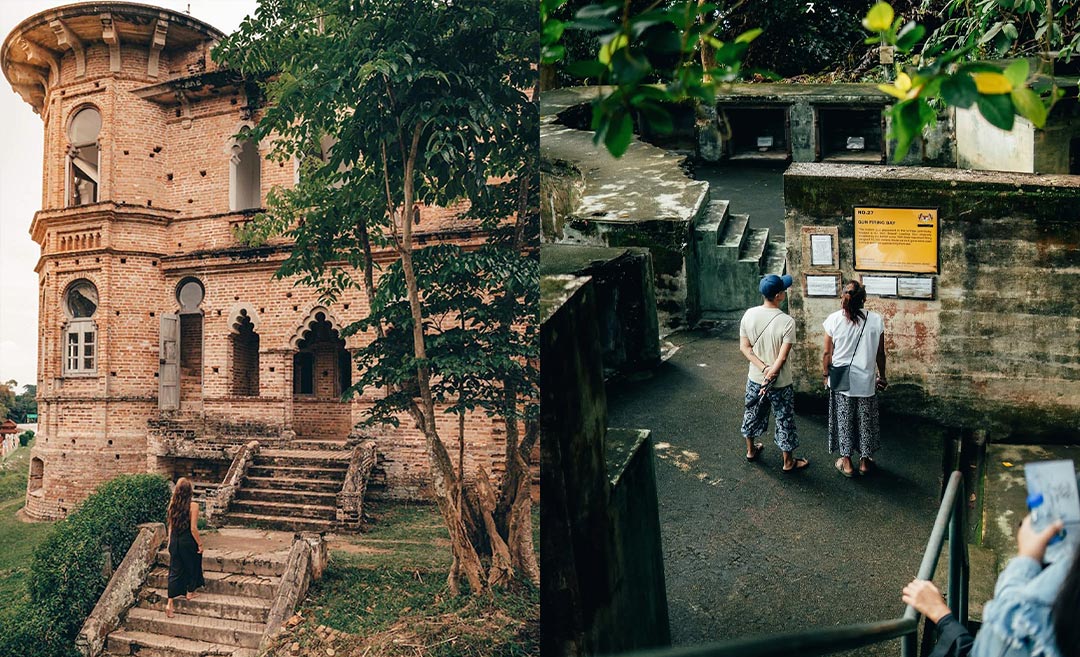
Built in the early 1900s, this impressive four-floor, fourteen-room mansion perches atop a hill in Batu Gajah, Perak. It was meant to be the dream home of Scottish rubber plantation owner, William Kellie-Smith, in then British-occupied Malaya. Kellie imported materials and brought in 70 workers from India for the construction of the mansion, with elements of Moorish, Indian, and Greco-Roman architecture.
Unfortunately, construction was delayed because of workers contracting influenza during the 1918 pandemic, which coincided with Kellie’s financial troubles, gradually leading to his deteriorating health. Before his “castle” could be completed, tragedy struck—Kellie died of pneumonia in 1926 during a short trip to Portugal. His widow eventually sold the property to a British company that ended up abandoning it years later.
Kellie’s Castle is believed to be one of the most haunted sites in Malaysia, with numerous reports of ghostly encounters on site, including the spectre of Kellie himself. More than just a symbol of a man’s unrealised dreams, the incomplete mansion continues to draw visitors captivated by the beauty of its architecture and intrigued by its reputation.
Address: Lot 48436, Kompleks Pelancongan Kellie’s Castle, KM 5.5, Jalan Gopeng, 31000 Batu Gajah, Perak
Penang War Museum, Penang
There’s no shortage of renowned war museums around Southeast Asia, but the largest is found at Batu Maung Hill, Penang. Built directly over 20 acres of preserved military grounds, visitors get to walk through real wartime tunnels and bunkers for a raw and immersive experience of Malaysia’s tumultuous times.
Originally a hilltop fortress built by the British in the 1930s to defend Penang’s southern coastline, the site was a strategic stronghold with underground tunnels, machine gun bunkers, and a command centre. In 1941, the invading Japanese army took over the fortress, turning it into a torture and interrogation camp during WWII. After the war, the site was abandoned and left to decay, with locals dubbing it Bukit Hantu (Ghost Hill).
Over time, the museum gained a reputation for being haunted, with visitors reporting seeing apparitions and hearing footsteps and strange sounds within the crumbling walls of execution chambers, bunkers, and escape tunnels.
Address: Penang War Museum, Jalan Batu Maung, 11960 Batu Maung, Pulau Pinang
Bank Kerapu War Museum, Kelantan
Originally built by the Mercantile Bank of India (aka Bank Kerapu) in 1912 on a local chieftain’s land in Kota Bharu, it is purportedly one of the oldest stone buildings in the state of Kelantan. During the Japanese occupation from 1941 to 1945, the building was used as the headquarters of the secret police known as the Kempeitai, where they interrogated and tortured prisoners.
After the fall of Japan, Bank Kerapu continued to function as a bank until 1992. It was then turned into a war memorial by the Kelantan Museum Corporation in 1994. The museum houses more than a thousand exhibits relating to Japanese-occupied Malaya, including wartime tools, weapons, and various artefacts.
Address: Jalan Pejabat Pos Lama, 15300, Kota Bharu, Kelantan
Villa Nabila, Johor
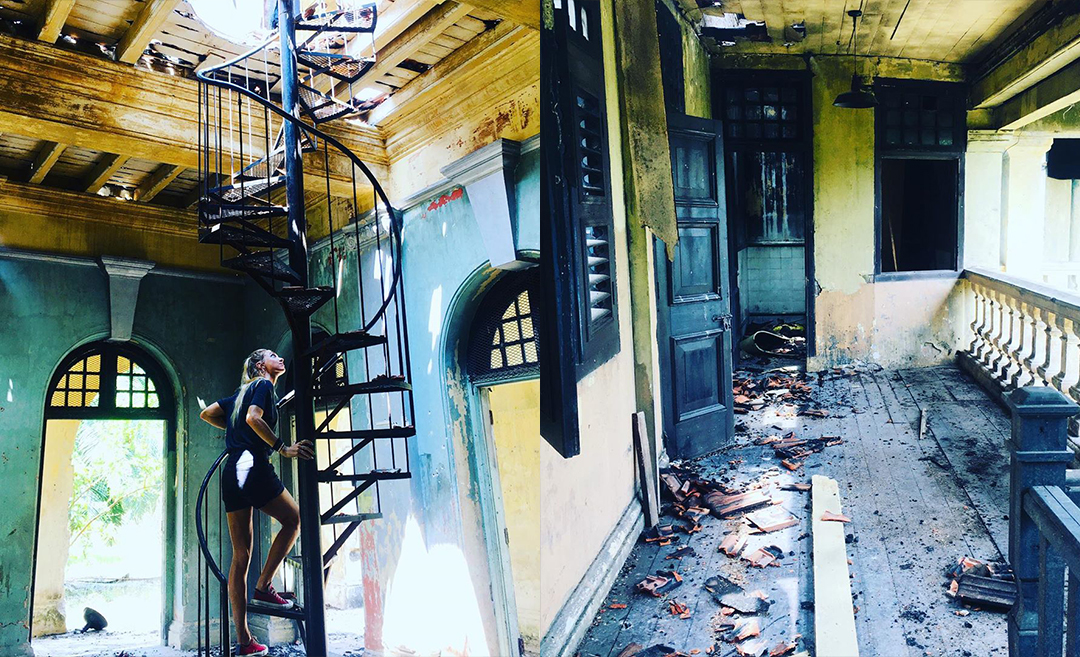
Overlooking Danga Bay stands an abandoned villa built in the 1930s in the style of European and Malay architecture. Over the decades, the now decrepit property known as Villa Nabila has garnered a reputation as one of the country’s most haunted locations, with a murky origin adding to its mystique.
The most popular tale of the villa’s past is that of a wealthy family who named it after their only daughter, Nabila. It is widely believed that the family met a tragic end, though versions of their demise vary. Some claim they were murdered during a burglary, while others believe it was the work of a killer hired by a rival family or the father himself who went mad after bankruptcy.
In another version of the story, Nabila was the heiress of a fortune that included the villa after her parents’ deaths. She was then murdered by a jealous maid who had her body encased in cement within the villa’s walls, leading to the belief that her wrathful spirit haunts the villa.
Whatever the true story may be, Villa Nabila continues to enthral and inspire those who dare tread its grounds. The structure was even the subject of a 2015 film of the same name, directed by Syafiq Yusof.
Address: Jalan Bertingkat Skudai, Straits View, 80200 Johor Bharu, Johor
Pudu Prison Gate, Kuala Lumpur
Built around 1891 by the British colonial government atop a cemetery ground, Pudu Prison was as infamous for its deplorable environment as it was for the many ghost stories surrounding it. Prisoners were housed in small unsanitary cells with a contaminated water supply from an old cemetery well, which caused a cholera outbreak in 1895 that killed hundreds. During its century-long function as Kuala Lumpur’s main prison complex, its impenetrable walls saw to the imprisonment and execution of countless notorious inmates, from Allied POWs (prisoners of war) to renowned criminals like Botak Chin.
Pudu Prison was demolished in phases starting from 2009 until 2012, with only its gate remaining. Today, the prison gate stands on the edge of a fountain park that is part of the Japanese shopping mall, LaLaport. Meanwhile, the Bukit Bintang City Centre complex now stands on the prison’s former site.
LaLaport Bukit Bintang City Centre
Address: 2, Jln Hang Tuah, Bukit Bintang, 55100 Kuala Lumpur
Monsopiad Heritage Village, Sabah
Headhunting, the practice of bringing home the severed heads of enemies as trophies, was practised by various tribes in the Borneo region, including Sarawak’s Iban and Sabah’s Murut and Kadazan-Dusun people. For generations, headhunting instilled fear in outsiders. Named after a legendary Kadazan-Dusun warrior, Monsopiad Heritage Village in Kota Kinabalu, Sabah is the place to learn about the gruesome legacy of the Borneo Headhunters.
Among the many interesting exhibits at the village are paddy planting tools, household items, and costumes honouring the life and times of Monsopiad and his descendants. The highlight, of course, is the House of Skulls, where all 42 of Monsopiad’s ‘trophies’ hang from the rafters.
Address: Kampung Kuai Kandazon, Jalan Putatan Ramayah, 89507 Penampang, Sabah
Kuching Old Courthouse, Sarawak
In the centre of Kuching’s old town is a beautifully restored colonial structure that belies a complex history. Built in 1874, the Old Courthouse was the centre of judicial and administrative power during the White Rajah era. It was once the venue for council meetings, royal celebrations, and historic state transitions, even serving as an execution ground during the Japanese occupation.
In 2003, the building was transformed into a heritage site and dining complex, with cafes, restaurants, and the Ranee Museum dedicated to Margaret Alice Lili De Windt, wife of the Second Rajah of Sarawak, Charles Brooke. Easily identifiable by a clock tower guarding its main entrance, the Old Courthouse is the place for history buffs and foodies to bask in the atmosphere of a bygone era.
Address: 7, Jalan Barrack, 93000 Kuching, Sarawak
Malaysia owes its cultural identity to a rich history of resilience, reflecting the nation’s ability to endure, adapt, and transform through periods of struggle and adversity. Take a journey back in time to these dark tourism sites and let history challenge and inspire you.