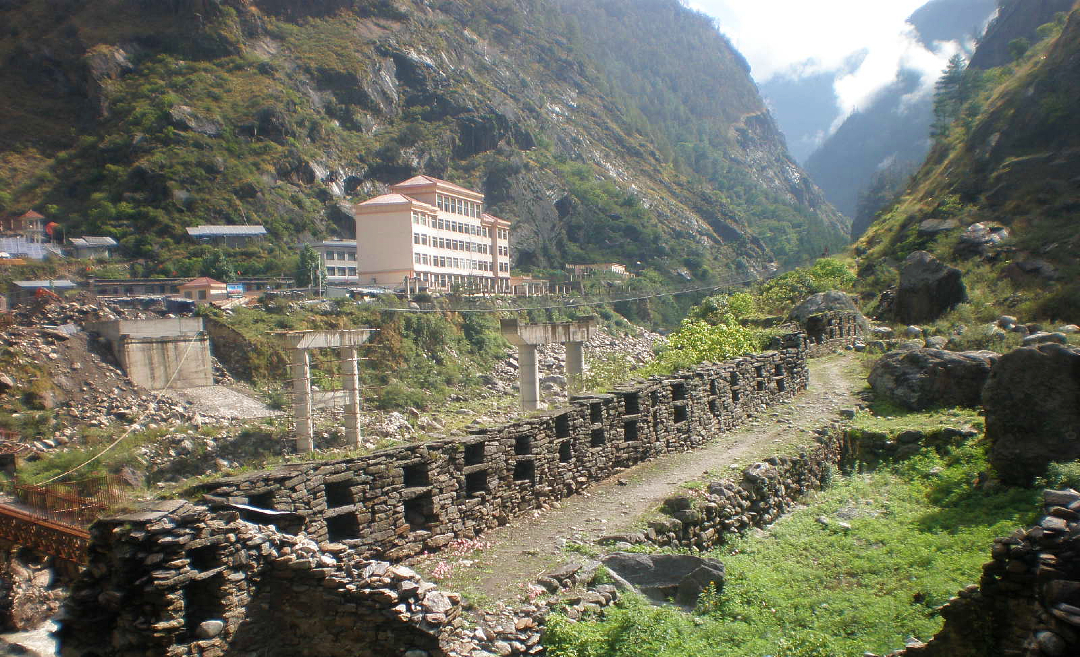
The China–Nepal Gyirong Port border crossing at Rasuwa Fort under construction in 2013. The vital travel and trade corridor was destroyed in the August 2026 floods, illustrating how vulnerable remote Himalayan routes can be. (Image by Krish Dulal)
The devastating floods that tore through Nepal’s Rasuwa district on 26 August have brought profound loss to local communities. Beyond the severe human toll, the flooding severed one of the main transport arteries connecting Nepal with Tibet, leaving a critical regional lifeline cut off.
A debris flow and flood, triggered by a rapid slope failure involving a glacier, travelled almost 100 kilometres through the Lhende Khola and Trishuli river systems, according to the US Geological Survey (USGS). he disaster claimed lives, left dozens missing, and displaced hundreds of residents while destroying or burying vital infrastructure, including the Rasuwagadhi border post and the principal highway connecting Nepal and China.
For those looking at remote travel and mountain landscapes, the event is a stark reminder of how deeply communities, trade, and regional movement depend on a very small handful of vulnerable roads, bridges, and mountain passes.
Why the Rasuwa–Kerung corridor matters
The Rasuwa–Kerung corridor links Nepal’s northern border with Gyirong in Tibet. On the Nepal side, the route passes through places including Timure and Syabrubesi — areas deeply tied to local commerce, trekking, and mountain tourism.
The floods destroyed the Sino-Nepal Friendship Bridge at Rasuwagadhi and severely damaged the road towards Dhunche. Dozens of truck drivers were left stranded in Kerung, while local officials noted that fully restoring the route could take months due to the complex terrain.
The corridor is also Nepal’s primary overland gateway for trade with China. According to The Kathmandu Post, it became an essential artery after the 2015 earthquake damaged the alternative Tatopani route, serving as a lifeline for moving food, medical supplies, and essential goods. When infrastructure like this is lost, the impact falls heaviest on the local families and workers whose livelihoods depend on these daily connections.
The vulnerability of Himalayan routes
Himalayan geography is defined by steep valleys, active river systems, and isolated settlements. However, these same geographic features leave infrastructure and transport networks heavily exposed to landslides, sudden floods, and severe weather.
The Rasuwa disaster is far more than a temporary road closure; it demonstrates how swiftly essential access can disappear when a single bridge or mountain road gives way.
A route may appear permanently established on maps or travel guides, yet remain physically vulnerable. When a primary link collapses, safe alternatives rarely exist. The Kathmandu Post reported that rerouting trade through Tatopani adds roughly 550 kilometres across terrain that remains equally vulnerable to seasonal hazards.
Ultimately, remote mountain destinations cannot be viewed in isolation from the infrastructure that sustains them. In regions shaped by high altitudes and fast-moving rivers, the roads, bridges, and crossings that connect these communities are not just transit points — they are vital lifelines for survival, relief, and economic stability.
How to support relief and recovery efforts
With roads washed away and remote villages cut off, humanitarian organisations are working to deliver clean water, medical aid, temporary shelter, and emergency supplies to affected communities across Rasuwa and surrounding districts.
If you would like to support relief operations on the ground, consider donating directly to verified disaster response organisations:
Malaysian relief channels
MAPIM: Coordinating direct humanitarian missions and aid distribution to remote communities.
Malaysian Red Crescent Society (MRCS): Accepting direct local contributions via CIMB Bank (Account Name: Malaysian Red Crescent Society | Account No: 8001581667 | Reference: Nepal Floods Appeal). Funds go directly toward emergency shelter kits, medical aid, and clean water distribution.
MERCY Malaysia: Supporting mobile health clinics, medical logistics, and humanitarian care for displaced families in disaster-affected areas.
International relief appeals
Direct Relief — Nepal Emergency Response: Deploying emergency medical supplies and operational grants directly to local healthcare teams and mobile medical units reaching isolated mountain health posts.
Nepal Red Cross Society / IFRC Flood Appeal: Supporting emergency search and rescue, clean water distribution, first aid kits, tarpaulins, and temporary shelter kits for displaced families.
Oxfam Nepal Floods Appeal: Delivering immediate humanitarian assistance, water sanitation supplies, and emergency hygiene support to hard-hit communities.