Street view? Sorted. Experience Phuket Old Town’s streets and heritage buildings up close with this walking guide. (Image from depositphotos)
Phuket may be known for its white sandy beaches and sparkling turquoise waters, but within its historic Old Town is where the heart of the island beats. The charming streets are lined with boutique hotels, hip cafes, handicraft shops, and a few tourist traps, all operating out of stunning heritage buildings. One full day spent in this walkable area will let you experience firsthand the rich history and cultural heritage of Phuket through museums, landmarks, and local food.
Here’s a tip: To make the most of your one-day visit, go on a Sunday.
Getting there and finding your way around town
Travelling between Phuket International Airport and the Old Town is convenient and affordable with the Airport Shuttle Bus 8411, which runs from 6am to 8pm. For a fare of only THB100, you can take the bus from the airport and get off at one of a few stops within the Old Town. The bus will also make several stops on the way to town, so do expect a 60- to 90-minute journey. For a quicker, albeit more costly route, you can take a taxi or book a ride on e-hailing apps like Grab or Bolt.
Ideally, you’d want to book a stay at one of the many hotels in the town area for your convenience. Once you get into town, finding your way around is a matter of knowing the streets where the main points of interest are.
Krabi Road
A quiet street dotted with local eateries and landmarks, Krabi Road makes for the best place to start your day. As you head east towards the town centre, you will come upon an alley that takes you off the road and leads you towards Chinpracha House. This Sino-colonial mansion-turned-museum was built in 1903 by a family that migrated from Fujian, China, during the tin mining boom in Phuket. Visitors can see the family’s personal belongings exhibited, and there are costume rentals available too, for those who fancy a personal photoshoot in the museum.
Keep walking on Krabi Road, and you will pass by the renowned Blue Elephant Cooking School & Restaurant. Even if you don’t fancy dining here, it’s worth stepping into the compound to quickly admire the building’s architecture.
Further up towards the livelier part of town is the Thai Hua Museum, a two-storey Sino-Portuguese building that was originally a school offering Hokkien Chinese classes. The museum houses exhibitions related to the unique history, traditions, and lifestyle of Hokkien Chinese migrants in Phuket.
Yaowarat Road, Dibuk Road, and Soi Romanee
As you keep going on Krabi Road, you will arrive at the busy junction of Yaowarat Road and Thalang Road. Take a leisurely stroll up north of Yaowarat Road towards the junction that intersects with Dibuk Road, where a turquoise building in the city’s characteristic Sino-Portuguese architectural style is impossible to miss.
At the junction, head east down Dibuk Road until you arrive at Mongkhon Nimit Temple, a beautiful Buddhist temple built in 1880. Across the street from the temple is the entryway into the short and narrow street of Soi Romanee, a street with a history as colourful as its buildings. Long ago, it was Phuket’s red-light district. Now, fancy cafes, ice cream parlours, and souvenir shops line the street, operating out of buildings that once served as brothels, opium dens, and gambling houses.
Thalang Road
Soi Romanee lets you cut across to the parallel Thalang Road. This is probably the part of town where you would spend a lot of time; every shophouse along this street has a distinct look. Here is where you will find good bargains for souvenirs, find respite from the heat in one of the dessert cafes, and take plenty of photos. Unlike in Bangkok, you will notice an absence of electric cables, because the Phuket municipality had them buried underground to preserve the beauty of the street.
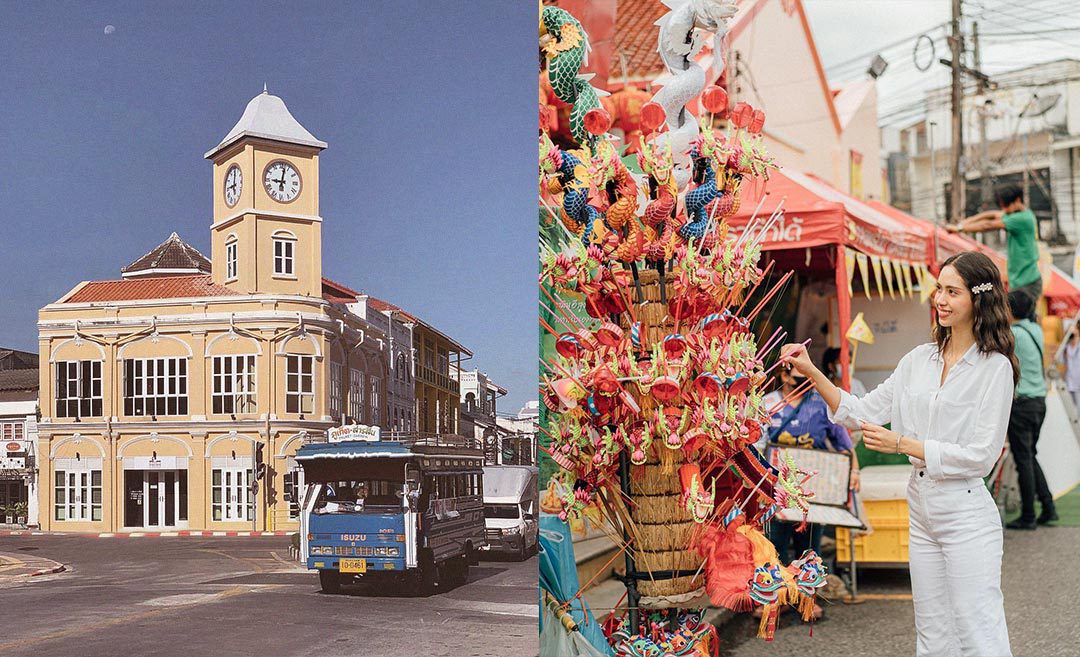
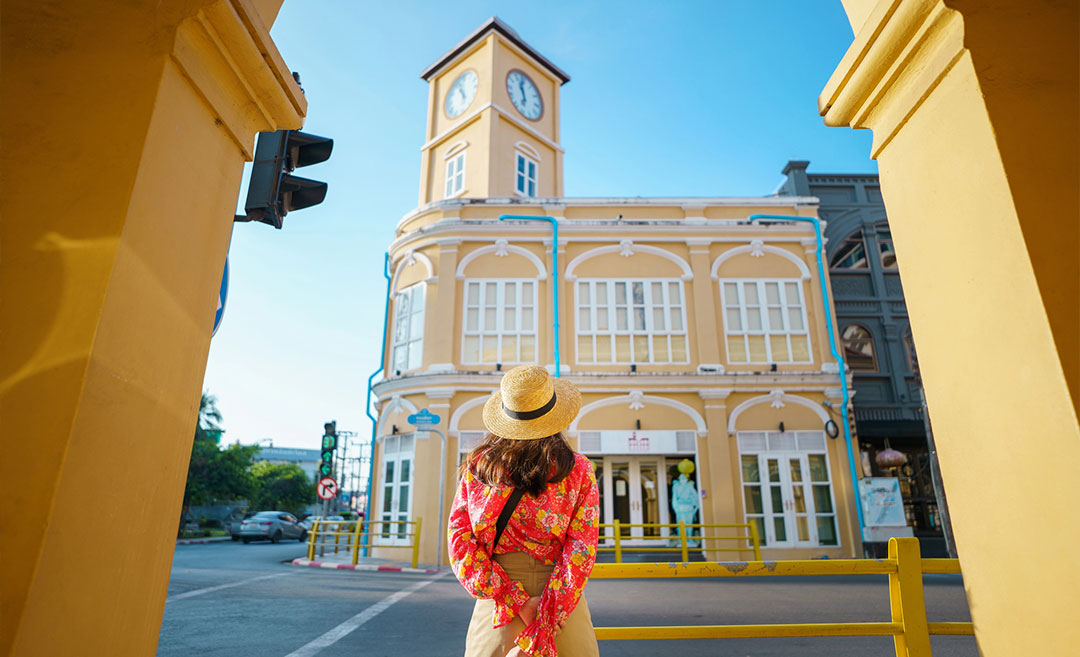
If you happen to be in this part of town on a Sunday, stick around for the Lard Yai Market that starts at 4pm. While you have time to kill, carry on eastwards on Thalang Road towards the T-junction of Thepkrasattri Road and head south to the junction where a pair of yellow buildings stand across from each other—one with a clocktower.
These historic structures are the Museum Phuket, which houses exhibitions on Phuket’s mining legacy, and the Peranakannitat Museum, showcasing the history of the Straits Chinese people. Both museums have special opening hours of 1:00pm to 8:30pm on Sundays to accommodate the night market crowd.
By the time you are done learning about Phuket’s cultural legacy, Thalang Road has come alive with street performers, merchants, and hawker stalls. The amount of street food, beverages, and goods offered is so staggering that it may feel overwhelming. So, be adventurous and give anything that catches your fancy a try. There’s definitely something for everyone.
One day may not be enough to see everything Phuket Old Town has to offer, but it may just be enough to make you fall in love with the island.