Explore 8 lesser-known Malaysian historical heritage sites, from military museums and colonial-era tunnels to ancient caves, offering eye-opening lessons on the country’s compelling and complex past. (Left image by @ipinotion. Right image by @kimberlyle_18.)
Across the 13 states and 3 federal territories of Malaysia are many museums, monuments, and geographical attractions preserving the memories of a colonial past, struggles for independence, and various tragic events that had a hand in shaping the nation. Often overlooked and sometimes even forgotten altogether, these historical heritage sites in Malaysia deserve a place on your itinerary if you seek to learn more about the country’s compelling and complex past.
Gua Kelam Recreational Park, Perlis
As one of Malaysia’s most enigmatic limestone caves, Gua Kelam is where nature and history intersect. The 370-meter passage was once a bustling tin mining tunnel that received its name, literally meaning “Dark Cave”, from the miners who had to toil in the dim glow of carbide lamps.
The cave was discovered in 1935 by Englishman Sir John Campbell, who saw that the flow of water in a cave could be used to transport ores from a nearby mine. He then had an eight-foot-wide wooden suspension bridge constructed over the cave’s subterranean stream, linking Kaki Bukit to Wang Tangga, a valley at the opposite end of the cave. This bridge facilitated mining operations and served as a shortcut for locals between Kaki Bukit and Wang Kelian, near the Malaysia-Thailand border.
Over the decades, Gua Kelam played a role in several historical events, including being used by the Japanese army during World War II, communist guerrillas and smugglers to transport ammunition. Today, Gua Kelam is embraced as one of Perlis’ natural attractions, with its storied past relatively unknown.
Kota Gelanggi Cave Complex, Pahang
Located about 30km from Jerantut town, the Kota Gelanggi Cave Complex covers an area of 147.3ha and houses over 100 limestone caves. Only a few caves are accessible to the public, including Gua Balai, Gua Terang Bulan, Gua Penyu, Gua Angin, Gua Kepala Gajah, Gua Gajah, Gua Sanding, Gua Potret, and Gua Tongkat.
In addition to its rich biodiversity and captivating geographical features, the nearly 150-million-year-old natural heritage site is linked to many folklores passed down orally by local communities. According to a well-known legend, the cave complex was a part of a lost city of an ancient kingdom. Hence, some of the caves’ formations resembling human figures are believed to be the result of an ancient curse.
The Kota Gelanggi Cave Complex is not for the average nature enthusiast, though. There are generally two types of guided tours to the caves offered: easy tours suitable for the whole family, and those for the adventurous explorers ready to rough it out. Whichever one you opt for, come prepared in proper trekking shoes and bring flashlights or headlamps.
Terengganu State Museum, Terengganu
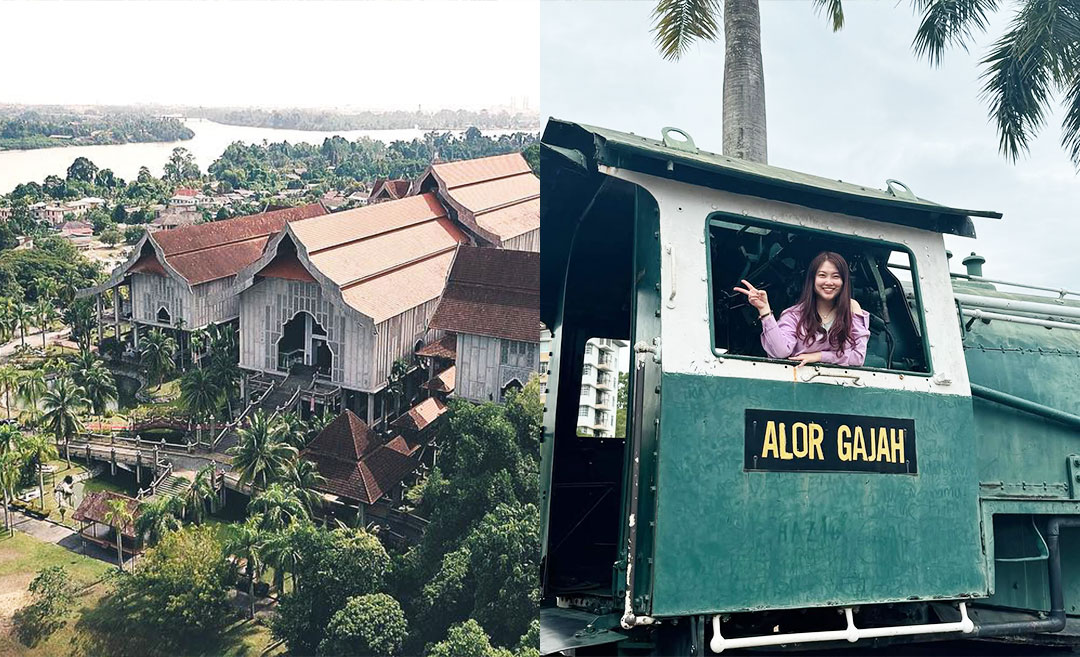
Covering 75,075 square meters and built in the style of traditional Malay architecture, the Terengganu State Museum is the largest state museum in Malaysia and one of the largest museums in Southeast Asia.
This grand palace-like building houses several galleries showcasing Islamic art, maritime history, royal regalia, textiles and an impressive collection of Malay weapons, some purported to be imbued with supernatural powers and were once wielded by legendary warriors. These exhibits are the remnants of the state’s past, rife with political conflict, piracy along the coast, and fierce resistance to colonial powers.
The Selangor State Memorial Monument, Selangor
Not to be confused with the National Monument in Kuala Lumpur, the Selangor State Memorial Monument (Tugu Peringatan Selangor) was built to honour the events and people in the state’s history.
Located in Shah Alam, near the Sultan Salahuddin Abdul Aziz Shah Building, the landmark was designed by architect Dato’ Hj Baharuddin bin Abu Kassim and constructed in 1981. The memorial site features a symmetrical park with a granite structure designed in the geometrical style characteristic of Islamic architecture. Besides the monument design, the serene environment of the surrounding landscaped gardens is ideal for an early morning or evening stroll when it’s not too hot.
Despite its historical and architectural significance, the monument is not widely known even among locals, leading it to be referred to as the Forgotten Monument.
The National Heroes Square, Putrajaya
Completed in 2016 in Precinct 1, The National Heroes Square (Dataran Pahlawan Negara) is one of the fairly new monuments built as a tribute to the nation’s fallen heroes in the fight for independence.
Surrounded by beautifully landscaped gardens and featuring a blend of traditional and modern design elements, the site is laid in a similar pattern to that of the Horse Guards Parade in London. Since its construction, it has taken over Dataran Merdeka as the venue for Trooping the Colour (istiadat mengarak panji-panji), the military ceremony held on the first, third and fifth years of a five-year King’s reign that signifies the military’s pledge of loyalty to the sovereign.
Army Museum Port Dickson, Negeri Sembilan
Managed by the Malaysian Royal Armed Forces, the Army Museum Port Dickson is a repository of the nation’s military prowess, history, evolution, and achievements from the colonial era to modern times. As the only military museum in the country, it is the place to learn about and experience the legacy of Malaysia’s warriors.
The museum comprises nine galleries showcasing uniforms, memorabilia, artefacts and weapons. Meanwhile, its spacious grounds hold outdoor exhibits of decommissioned military vehicles and artillery pieces, including aircraft, helicopters and armoured vehicles.
The Malaysia Prison Museum, Melaka
Most of us, thankfully, will never get to know the inside of a prison. For those who are curious about life behind bars, the Malaysian Prison Museum offers a glimpse of that grim reality.
Built in 1860, the Bandar Hilir Prison reopened as the Malaysia Prison Museum in 2014. Along with photos and artefacts from other notorious prisons around the country, the museum kept most of its original facilities, equipment, and furniture intact as exhibitions. Even some of the cells have been kept in their original state, complete with stains and graffiti on the walls left by prisoners.
Those who dare can visit the cellblock where death row inmates were housed and the execution room where the gallows are.
Surrender Point, Labuan
On 10 September 1945, Major General George F Wootten, Commander of the 9th Australian Division, accepted the unconditional surrender from Lieutenant-General Masao Baba, Commander of the 37th Japanese Army. The event marked the end of the Japanese Occupation in Borneo, subsequently ending the Second World War.
On a small beach-side park overlooking the South China Sea on the western side of Labuan Island, a memorial stands at the spot where the official surrender ceremony took place in a wooden shack. In contrast to this solemn reminder of a tragic past is the serene coastline a stone’s throw away.
These destinations preserve fragments of the past that could give us a deeper understanding of Malaysia’s trials and tribulations. They may not be the happiest places to visit, but they might just offer the most eye-opening experience.