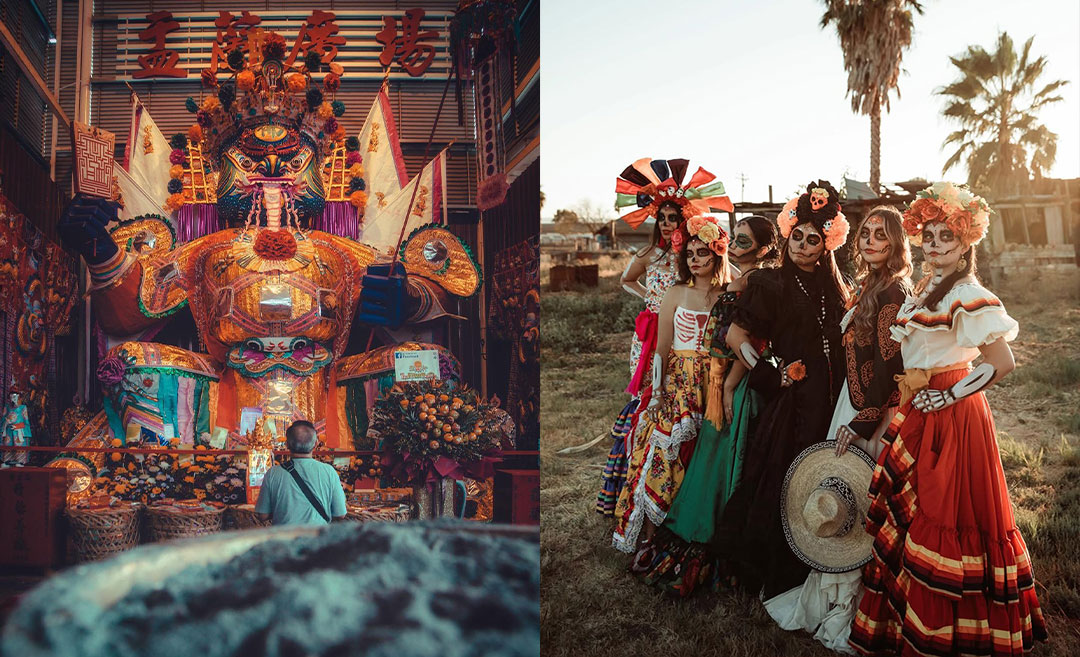
Does the dark and morbid bring you comfort? Here are festivals of the dead you can experience while you’re out exploring the world. (Left: Image by @terryyteohh. Right: Image by @cariimendoza.)
In many cultures around the world, there is a widely held belief that at certain times of the year, the line between the living and the dead is thin. This is the time when souls of the deceased temporarily return to the material plane for a visit.
We’re about to look at some of these annual cultural and religious festivals that celebrate and honour the dead during their brief sojourn. If your travels ever coincide with these festivals, do not pass up on the chance to witness and experience them.
Hungry Ghost Festival
China, Taiwan, Hong Kong, Malaysia, and Singapore
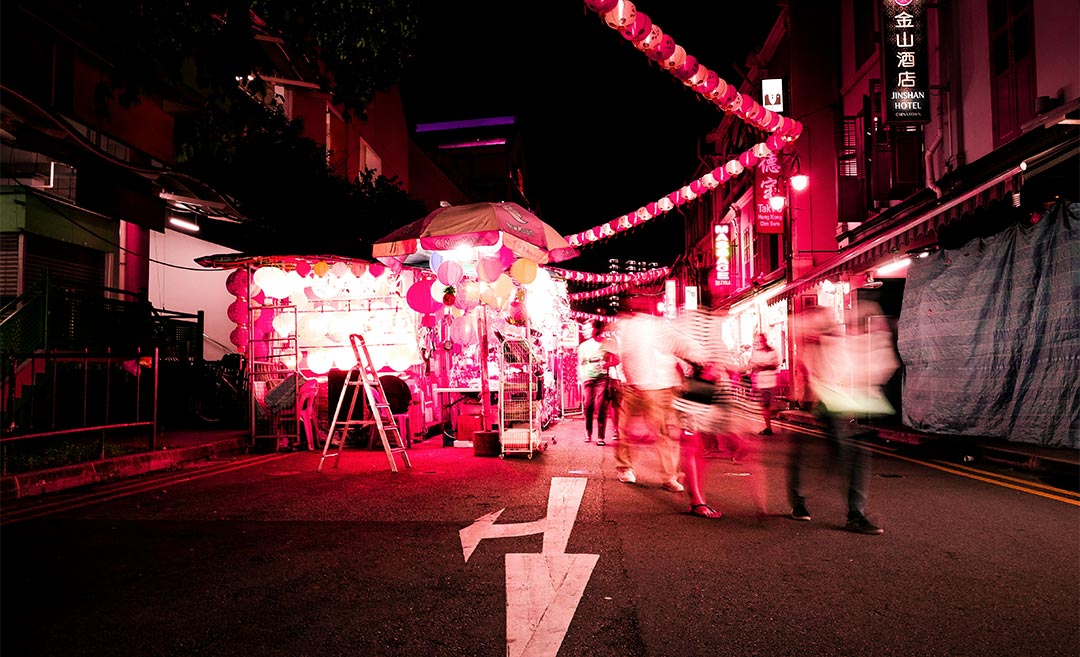
According to Taoist and Buddhist folk beliefs, the souls of those who passed away without descendants or whose descendants failed to honour them after death become spiteful, restless, and hungry. Hence, on the 15th day of the seventh month of the lunar calendar – which usually falls around late July to early September – the Hungry Ghost Festival is observed. Food offerings are laid outdoors with incense, and joss papers are burned to appease these spirits. Meanwhile, prayers will be held at home to welcome returning ancestors.
In neighbourhoods around town, expect to see makeshift stages (getai) erected for concerts and Chinese opera performances. Members of the public are welcome to attend these events, just don’t sit in the empty front row seats, as they are purposely reserved for the ghostly guests.
Obon
Japan
As a traditional Buddhist festival, Obon commemorates the spirits of ancestors returning to visit the living. Like the Hungry Ghost Festival, Obon is traditionally celebrated on the 15th day of the seventh lunar month. Today, most Obon festivities around Japan are held around mid-August.
During the festival, the deceased are honoured through toro nagashi, the floating of lanterns down a river. Paper lanterns can be seen hanging outside houses to guide visiting ancestors back home. At public places and temples, Bon Odori, a traditional folk dance, is performed to welcome souls of the dead into the world of the living. In Kyoto, the end of Obon is marked by the lighting of large bonfires on hills surrounding the city to guide souls back to the spirit world.
Día de los Muertos
Latin America and the United States
Originating from Mexico, Día de los Muertos – Day of the Dead – is a fusion of indigenous and Christian beliefs and customs. The festival is celebrated over two days, All Saints’ Day on 1 November and All Souls’ Day on 2 November. As a festival of remembrance, Día de los Muertos is marked with vibrant colours and images of skeletons to symbolise death and rebirth. Gravesites are cleaned and decorated with flowers and photos of the deceased, creating beautiful altars where food offerings are made.
In homes, altars known as ofrendas are erected in memory of deceased loved ones, displaying their favourite food, photos, mementoes, religious icons, and small edible sugar skulls known as calaveras. Parties, parades, and dances happen around town, where it is believed that spirits of the dead partake in the festivities alongside the living.
Samhain
Ireland and the United Kingdom
Celebrated on 31 October and 1 November, Samhain (pronounced SAH-win) marks the end of the harvest season and the beginning of winter, when days are short and nights are long. While most of the world may be more familiar with its commercialised version, Halloween, the festival actually has deep roots in ancient Celtic and Gaelic traditions. Originally a pagan festival, Samhain incorporated elements of Christianity by merging it with All Saints’ Day.
Because ghosts are free to cross over to the world of the living, offerings of food are placed outside of houses. To avoid falling prey to wandering evil spirits, it is customary to dress up in scary costumes as a disguise. Different parts of the United Kingdom have various Samhain practices specific to the region, including parades, pumpkin carving contests, street carnivals, bonfires, fireworks, and festive pastries like Soul Cake for sale.
Pchum Ben
Cambodia
Around mid-September and mid-October each year, life in Cambodia slows down in observance of one of the most important festivals in the country. Also known as Ancestor’s Day, Pchum Ben lasts for 15 days, during which spirits return to visit living relatives, who must help their souls with atonement to attain liberation.
Like the Chinese Hungry Ghost Festival, the wandering spirits are believed to be hungry. Thousands flock to pagodas wearing white, as it is the customary colour for mourning, to make food offerings for the deceased. Rice balls are ritualistically tossed in graveyards and temples for the hungry ghosts.
Because Pchum Ben is such an important festival, visitors can witness the festivities in any Cambodian city. Remember: it is a spiritual event, so be sure to observe certain respectful conduct, such as wearing white and avoiding revealing clothing.
Chuseok
Korea
Unlike the other aforementioned festivals of the dead, Chuseok is more of a festival for giving thanks. Celebrated on the 15th day of the eighth lunar month – sometime around mid-September to mid-October – it is the largest national holiday observed throughout North and South Korea. The three-day festival coincides with the fall harvest, with rituals performed to give thanks to ancestors for their blessings of bountiful crops.
Families celebrate Chuseok by visiting ancestral graves to clean and tidy them and hold memorial services in the ancestors’ honour. The festivities also include traditional dances, folk games, and food, most notably songpyeon, a traditional crescent-shaped steamed rice cake commonly made during this festival.
To fully experience Chuseok, consider visiting any one of South Korea’s well-preserved ancient villages that host special celebrations for the holiday.
Death is the only certainty in life. Not only do these festivals reflect our complex relationship with this inevitability, they also honour ancestors who came before us and keep the memories of loved ones who are no longer with us alive.