Malaysia’s architectural landscape tells the rich story of its multicultural heritage and tumultuous past. The best part? You can visit these stunning spots. (Left: Image by @chicawanderlust. Right: Image by @wiwitalfyan.)
Malaysia’s architectural landscape offers a plethora of traditional craftsmanship, colonial grandeur, and modern innovation. From heritage sites to humble gems, here are some of the most beautiful styles you can explore across the country.
1. Bornean
Sarawak Cultural Village (Kuching)
📍Location
From Bidayuh, Iban, and Orang Ulu communal longhouses to the Melanau Tall House, Sarawak Cultural Village is an award-winning living museum that gives you the chance to experience the cultures, lifestyles, and architectures of seven major ethnic groups.
Borneo Cultures Museum (Kuching)
📍 Location
Drawing inspiration from Sarawak’s cultural diversity, traditional craft motifs, and the New Sarawak State Legislative Assembly Building, the Borneo Cultures Museum is a uniquely modern take by Sarawakian architect Dato’ Sri John Lau Kah Sieng.
2. Traditional Malay
Rumah Penghulu Abu Seman (Kuala Lumpur)
📍Location
One of the oldest surviving traditional Malay houses, it was built in stages between 1910 and the early 1930s in Kedah and is one of the finest remaining examples of Malay vernacular architecture.
Istana Kenangan (Kuala Kangsar)
📍Location
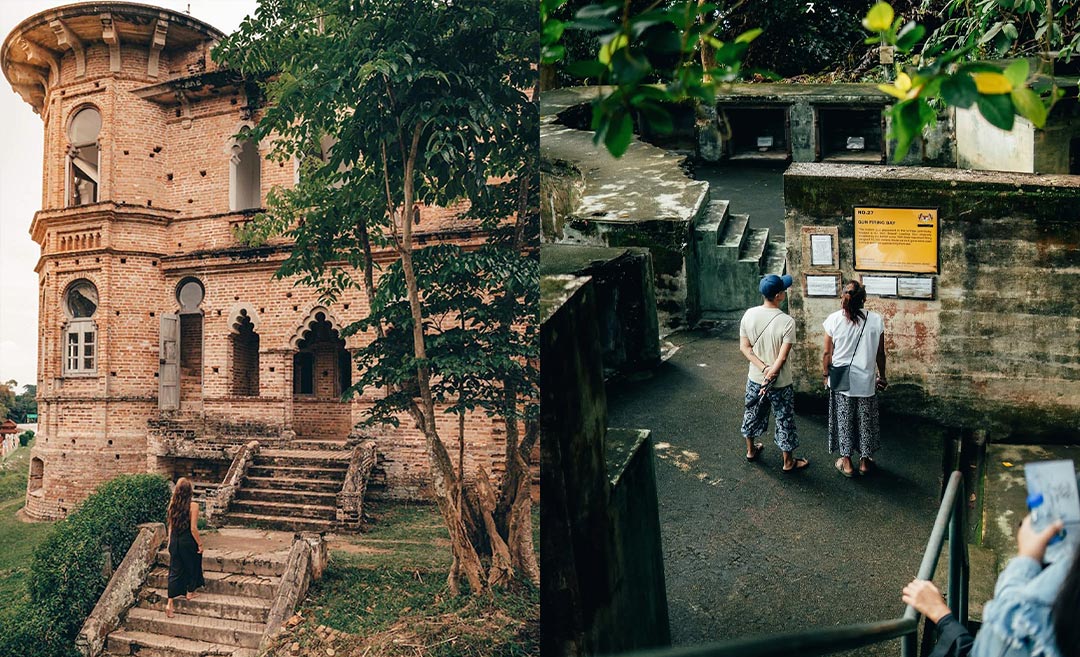
Built in 1926 for Sultan Iskandar Shah by Malay carpenter Enci Sepian, the royal residence, Istana Kenangan, now houses the Perak Royal Museum. Constructed entirely of wood, the palace showcases the beauty of Malay carvings and woven patterns.
3. Islamic
Kompleks Dayabumi (Kuala Lumpur)
📍Location
A major Kuala Lumpur landmark and one of the city’s first skyscrapers, the Dayabumi was constructed in the 1980s with the footprint of an eight-pointed star, Islamic arches, and a beautiful Arabesque Zellij (Islamic Geometry) façade.
Masjid Wilayah Persekutuan (Kuala Lumpur)
📍Location
Reminiscent of Istanbul’s Blue Mosque, Masjid Wilayah Persekutuan’s (The Federal Territory Mosque) design takes inspiration from Ottoman, Umayyad, Indo-Persian, and Malay architectural styles.
4. Indian
Sri Shakti Devasthanam Temple (Kuala Selangor)
📍Location
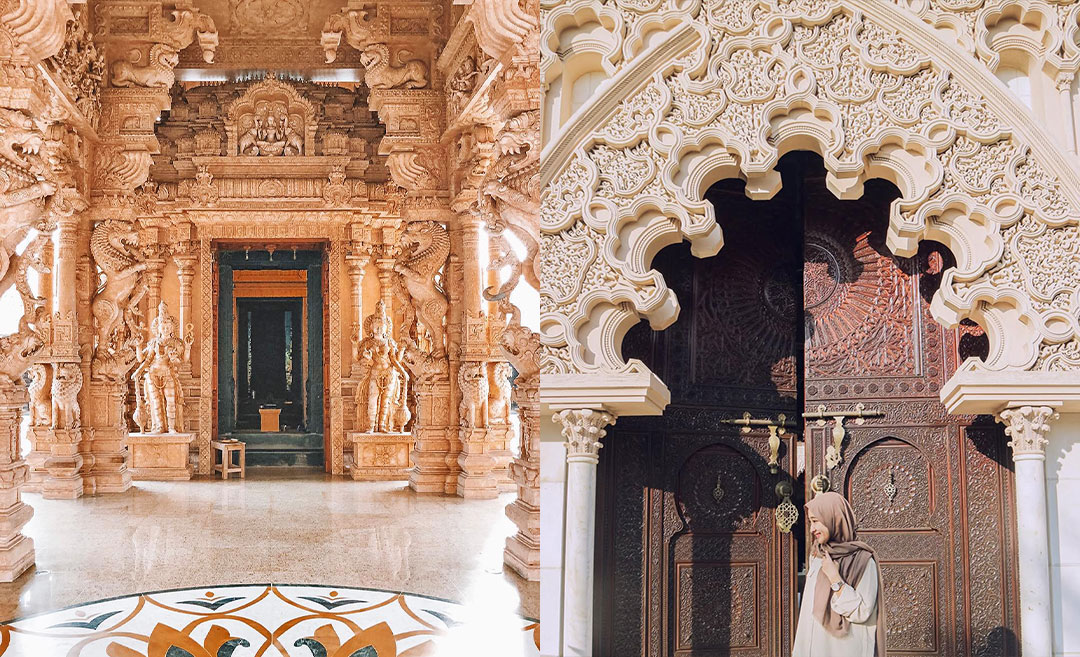
This majestic cashew-sand-coloured temple is a breathtaking example of Hindu architecture at its finest. Among its unique features is an ‘island’ within the temple complex, built using a sculptural technique called Thundu Pattirippu Pathroba Pathram, which is notoriously fine, delicate, complex, and therefore rarely employed in temple construction.
5. Chinese
Thean Hou Temple (Kuala Lumpur)
📍 Location
Modelled from ancient architecture, Thean Hou Temple is a grandiose, colourful, six-tiered structure that blends both traditional and modern architectural styles with Buddhist, Confucian, and Taoist elements.
Kek Lok Si Temple (Penang)
📍Location
Malaysia’s largest Buddhist temple, Kek Lok Si, is a sprawling complex of intricate design. Think carvings, sculptures, murals, architectural lines, colour, and twinkling lights galore. It’s also situated on a hill, so expect incredible sweeping views or a temple shrouded in mist.
6. Sino-Portuguese aka Chinese Baroque aka Straits Eclectic
Cheong Fatt Tze, aka The Blue Mansion (Penang)
📍Location
Constructed following Feng Shui principles and influenced by Chinese, Malay, and European styles, this opulent indigo icon was once the home of Cheong Fatt Tze, a Chinese businessman nicknamed ‘the Rockefeller of the East.’
7. Indo-Saracenic aka Neo-Mughal
Sultan Abdul Samad Building (Kuala Lumpur)
📍Location
This grand 1800s government building features copper domes, red bricks with white plastered banding and arches, and a large central clocktower with a one-tonne bell.
Other breathtaking Mughal-eclectic buildings include: the City Theatre, National Textiles Museum, Masjid Jamek, former High Court and later Supreme Court, the old Kuala Lumpur Railway Station, and the Ipoh Railway Station, many of which were designed by architects A.C. Norman and A. B. Hubback.
8. Moorish
Moroccan Pavilion (Putrajaya)
📍Location
The Moroccan Pavilion in Putrajaya is an exquisite Moorish monument adorned with intricate carvings, stunning tiles, and surrounded by lush, meticulously landscaped gardens. The materials were imported from Morocco, while Moroccan craftsmen were flown in to ensure cultural authenticity.
9. Tudor Revival
The Bala’s Holiday Chalet (Cameron Highlands)
📍 Location
This English mock-Tudor house, built in 1935, is one of the oldest colonial buildings in Cameron Highlands. Once a boarding school, it is now a quaint holiday chalet known for its traditional English tea experience in an old-world setting.
10. Neo-Gothic
Church of the Holy Rosary (Kuala Lumpur)
📍Location
Considered one of the finest examples of Neo-Gothic architecture in Malaysia, the Church of the Holy Rosary is instantly recognisable by its lancet doors, tracery, pointed arches, and white facade.
11. Neoclassical
Sultan Abdul Aziz Royal Gallery (Klang)
📍Location
Another A. B. Hubback building, it was built in 1909 and features columns, symmetry, porticos, and blank walls, typical of the Neoclassical style. Beautifully restored, it is now a window into the rich history of the Selangor Sultanate.
12. Art Deco
Logan Heritage Building (Penang)
📍Location
Built in 1883, the Logan Heritage Building (now an arcade of retail shops and eateries) was originally designed in the Victorian style, with cast iron balconies, a granite porte-cochère, and all. It fell into disrepair, was redesigned in the Art Deco style (fashionable in the 1930s), and was recently restored to its former glory—hence its hybrid Victorian-Art Deco elements.
Art deco buildings in Kuala Lumpur that’ll make you do a double take include: Central Market, Oriental Building, Anglo-Oriental Building aka Wisma Ekran, and the old OCBC Building, the majority of which were designed by just one architect—Arthur Oakley Coltman.
13. Brutalist
Dewan Tunku Canselor (Kuala Lumpur)
📍Location
Brutalism. You either love it or hate it. But in Malaysia’s climate, it is both stylistic and practical. The Dewan Tunku Canselor, designed by Datuk Kington Loo, features the typical extensive use of raw concrete (béton brut), an imposing presence, and the use of natural light to enhance its design.
14. Modernist
Malaysian Houses of Parliament (Kuala Lumpur)
📍Location
Designed by William Ivor Shipley and built in 1963, the Malaysian Houses of Parliament is a stunning complex of a three-storey main building and an iconic 17-storey tower. Designed to be functional and simplistic, it incorporates design motifs that encapsulate Malaysian identity, as well as features that are climate-appropriate.
Important tip to note: Submit a formal application at least five working days before your visit. Find instructions here.
15. Contemporary
Crystal Mosque (Terengganu)
📍Location
Steel, glass, and crystal comprise this opulent mosque constructed on a man-made island. Masjid Kristal is a dazzling sight that reflects architectural innovation and symbolises the harmonious blend of traditional Islamic values and contemporary aesthetics.