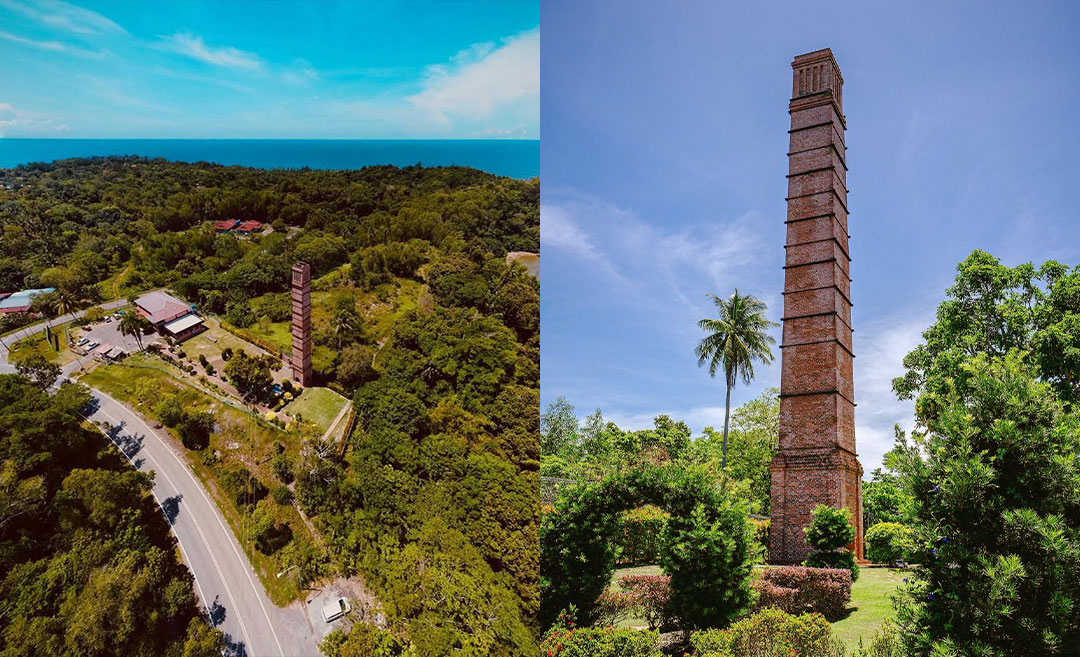
This red-bricked monolith in Labuan stands tall as a reminder of its coal mining history, but its true purpose remains unknown. (Left: Image by @__wanproduction. Right: Image by @kengishima.)
There’s a burning mystery behind the Chimney, a lofty landmark in Labuan, an island federal territory off the coast of East Malaysia’s Sabah state.
Standing 32.5 metres tall, the red brick monolith was once thought to be a ventilation shaft for the underground coal mines of Tanjung Kubong in the island’s north.
However, subsequent investigations showed that it may not have had anything to do with mining at all. In fact, the true purpose of this structure, known locally as Punil (a corruption of “funnel”), remains a puzzle.
A tower with a mysterious past
Some historians believe that the Chimney dates back to the late 19th century, when coal mining was at its peak in Tanjung Kubong under the British North Borneo Chartered Company.
Situated near the area’s main coal deposits, it was long assumed that the tower was built as an air shaft for subterranean mines. However, this theory was disproved in 1997 following a major conservation exercise by the Department of Museums Malaysia.
Excavation works revealed that there were no mines or tunnels below the chimney. Instead, there were as many as 12 layers of bricks beneath the tower – presumably to provide a solid foundation – thus ruling it out as an underground ventilation outlet.
Since then, various theories have been put forth as to the Chimney’s purpose, from a lighthouse or bell tower for ships passing in the bay below to a telecommunications mast during the British colonial period.
Some experts believe the structure could have been used as a smokestack for a kiln, especially given the presence of a brick-making factory at the Tanjung Kubong site. But tests have shown that its inner walls bear no sign of ever being used for burning or smelting.
Despite an abundance of speculation, none of these theories have been proven. Most mining activities ceased by the 1920s due to decreasing output and the area was largely abandoned and forgotten, leaving only the tower and its mysteries behind.
A mine of information
In an effort to educate the public about this unique structure, the Chimney Museum was opened in 2002. The museum is housed in a two-storey building reminiscent of colonial era schools in Labuan.
The museum showcases the history of coal mining in Tanjung Kubong, particularly between 1847 and 1911 when the industry was at its peak. It features a range of exhibits, including historical photographs, mining artefacts, life-sized dioramas, and architectural models.
Artefacts on display include the different types of coal mined in Tanjung Kubong, old mining equipment, locomotive components from Labuan’s coal transportation trains, and archival photos depicting the early days of the mines.
The second floor of the museum is dedicated to the Chimney, including its murky origins. Theories notwithstanding, it does lay out some detailed facts—for instance, as many as 23,000 bricks imported from England were used to construct the tower’s outer walls.
The exhibit also highlights the design of the tower, which is square-shaped and built in the “typical English architecture” style.
A walk through history
Curious travellers with more time to spare should consider embarking on the Labuan Chimney Walking Trail, one of the island’s most popular walking routes.
Starting at the Chimney, the trail passes five British tombstones dating back to 1866, an old vertical coal mine shaft that goes as deep as 40 metres, and Gedung Ubat, a bunker said to have been used by the Japanese during World War II to store ammunition.
This literal walk down history lane ends at a cliff at the tip of Tanjung Kubong, which offers breathtaking panoramas of the South China Sea.
The Chimney and museum are open daily except for the first and second day of Hari Raya Aidilfitri, and on the first day of Hari Raya Aidiladha. Admission is free.
For history buffs, it’s a must-see when in Labuan, although many casual visitors enjoy stopping by to admire its photogenic qualities as well.
Address: Muzium Chimney, Kg Lubok Temiang, Jalan Tanjung Kubong, 87008 Wilayah Persekutuan Labuan
This story by Jacie Tan Cheng Hwee was originally published on AirAsia. Zafigo republished this story in full with permission from the publisher, simply because good stories should be read by as many people as possible! If you have stories that will be of interest and useful to women travellers, especially in Asia, please get in touch with us at [email protected].