These mesmerising moon gates, moon bridges, and natural rock formations around the world offer a magical gateway into history, nature, and imagination. (Image by PromesaStudio)
What if we told you that you don’t need a space shuttle to travel to the moon, but just a gate – a moon gate, to be precise?
Space tourism may no longer sound like pure science fiction, but for most of us, seeing the moon up close still comes with a price tag well beyond reach.
Thankfully, there are otherworldly places around the world where moon gates, moon bridges, and stone arches capture a little of that same magic.
No, they won’t transport you across the galaxy, but these circular gateways, bridges, and natural rock formations have inspired stories of portals, new beginnings, and hidden worlds for centuries. Scattered across beautiful destinations around the globe, they’re well worth adding to your travel wishlist.
What are moon gates?
Legend has it that in ancient China, people believed there were two moons in the sky. When these moons aligned perfectly, a portal would open, forming a connection between Heaven and Earth. This is said to be where the name yueliangmen (月亮门), or “moon gate”, originated.
With their Chinese origins, moon gates are part of traditional Chinese architecture, serving as openings between gardens and courtyards. Traditionally, these circular gateways were found in the homes of wealthy families, where they symbolised welcome, harmony, and good fortune.
While many moon gates are built into walls, the architectural style eventually spread beyond China. Today, free-standing moon gates can be found in gardens and public spaces around the world, each carrying its own cultural symbolism. Many people still believe it’s good luck to walk through one.
Ancient moon gates and natural stone arches
Moon Hill in Guilin, China
If you’re traversing in and around Guilin, don’t miss this remarkable natural formation just a few kilometres outside Yangshuo County. Also known as Moonlight Mountain, it’s named after the enormous semi-circular arch that resembles a rising moon. One of the region’s most popular attractions, reaching the summit requires a brisk 20-minute hike.
Elephant Trunk Hill in Guilin, China
Continuing on your voyage amongst the majestic mountains in Guilin, and located an hour’s drive away from Moon Hill, is where you can find the Water-Moon Cave embedded in Elephant Trunk Hill. During the night, it’s said that the reflection of the water and the cave’s shape create a beautiful illusion of the moon floating on the river. The cave has inspired generations of poets and scholars, and visitors can still see inscriptions dating back to the Song dynasty carved into its walls.
Mên-an-Tol in Cornwall, United Kingdom
Located about a 12-minute drive from Madron in Cornwall, the Mên-an-Tol stone formation dates back to the early Bronze Age, making it around 3,500 years old. Locally known as the ‘Crick Stone’, it’s surrounded by folklore, with legends claiming it can cure ailments and even improve fertility.
The Great Arch of Tabuk in Saudi Arabia
The sandstone landscapes of northwest Saudi Arabia are full of dramatic rock formations, but few are as striking as the Great Arch of Tabuk. Carved naturally over thousands of years by wind and erosion, the towering arch rises from the desert like a giant stone portal. Its near-perfect curve frames endless views of rugged cliffs and open skies. Visit around sunrise or sunset, when the golden light transforms the arch into an even more surreal sight.
Moon gates in beautiful gardens around the world
The Humble Administrator’s Garden in Suzhou, China
As one of the most famous gardens in Suzhou, China, and listed as a UNESCO World Heritage Site, The Humble Administrator’s Garden is a stark contrast amidst the hustle and bustle of modern-day China. With its calming, zen-like charm, it’s no wonder that the garden is a valuable cultural relic worth visiting.
Las Pozas, Xilitla, México
Las Pozas was British poet Edward James’ passion project. It’s a surrealist’s playground, built with preserving the surrounding Mexican jungle in mind. At the entrance of Camino de los 7 pecados capitales (Road of the Seven Deadly Sins), a moon gate whisks away all sense of normalcy and transforms the tropical landscape into an otherworldly art museum with free-standing structures of gravity-defying heights.
Red Brick Art Museum in Beijing, China
If you have a fond appreciation for all things art- and architecture-related, head on towards the Red Brick Art Museum located in the Chaoyang district of Beijing. This red-brick behemoth boasts 10,000m² of exhibition space. Designed to harmonise industrial architecture with nature, the museum offers a welcome contrast to the bustle of Beijing, where contemporary art and tranquil courtyards exist side by side.
Guilin Park in Shanghai, China
Initially a private residence, the urban park has become a popular place to unwind amongst the locals. We can definitely see why! With its elaborate oriental decor suitable as a backdrop for taking outfit photos and hanfu cosplaying, it’s no wonder that many come to this place to fully immerse themselves in traditional Chinese garden architecture. The entrance fee to the park is only RMB2 (approximately USD0.31 or RM1.30).
Kinney Azalea Gardens in Rhode Island, USA
Nestled in Kingston, a village in Washington County, is a botanical garden famed for its extensive collection of azaleas and rhododendrons. The Kinney Azalea Gardens is one of Rhode Island’s best-kept secrets hidden behind a historic home. Locals flock here on weekends to enjoy the scenery, have a picnic, and take postcard-worthy photos during the blossoming season (from early February to September).
Chinese Garden at Jurong Lake Gardens, Singapore
One of Singapore‘s most recognisable moon gates can be found within Jurong Lake Gardens. Inspired by classical imperial gardens from northern China, the landscape features elegant pavilions, zigzag bridges, pagodas, and traditional moon gates that frame the scenery like living paintings. Whether you’re admiring lotus ponds, watching turtles bask in the sun, or escaping the city’s fast pace for an afternoon, it’s an easy place to slow down and appreciate the timeless beauty of Chinese garden design.
Moon bridges with perfect circular reflections
Rakotzbrücke in Saxony, Germany
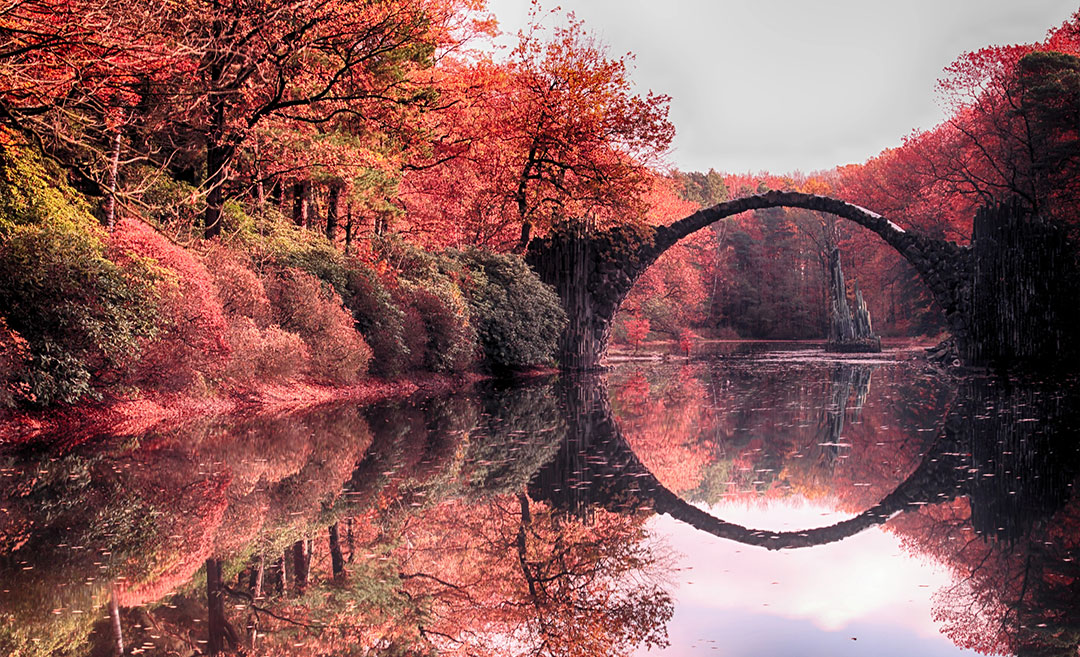
Located in Kromlau Park, this 19th-century bridge was specifically designed and built to form a perfect circle (or moon) when reflected against the waters beneath. Otherwise known as The Devil’s Bridge, its name came about from the belief that the precariously-built bridge is dangerous for a mere mortal to construct and cross, that it must have been the work of Satan.
Unbothered by tales of the devil, many have come to visit the park to catch a glimpse of the symmetrical reflection. However, tourists are not allowed to cross the bridge due to conservation purposes.
Koishikawa-Kōrakuen in Tokyo, Japan
The Koishikawa Korakuen Gardens is an Edo-period park situated in the busy city of Tokyo, Japan. You can find multiple miniature replicas of famous landmarks from Japan and China peppered across the park, and is a fun activity to do while having a relaxing stroll. While walking through the picturesque grounds, you’ll come across a stone bridge named Engetsu-kyo. True to its name, the small stream beneath the stone bridge casts a perfectly circular reflection resembling the moon.
Moon Bridge in Taipei, Taiwan
If you’ve ever admired photos of Taipei’s perfectly reflected Moon Bridge, chances are they were taken at Dahu Park. Stretching across the lake, the elegant white bridge creates a near-perfect circle when mirrored on calm water, especially after sunset when it’s illuminated against the city skyline. Surrounded by walking trails and lush greenery, the park is a peaceful escape from Taipei’s busy streets. Sometimes the simplest designs leave the biggest impression.
While moon gates may not transport you to another world, they do offer something just as magical: a new perspective. The next time you find yourself standing before one, step through—you never know what memorable journey might be waiting on the other side.
Editor’s note (July 2026): This article has been updated with refreshed information, editorial improvements, and additional moon gate destinations to inspire future travels.