
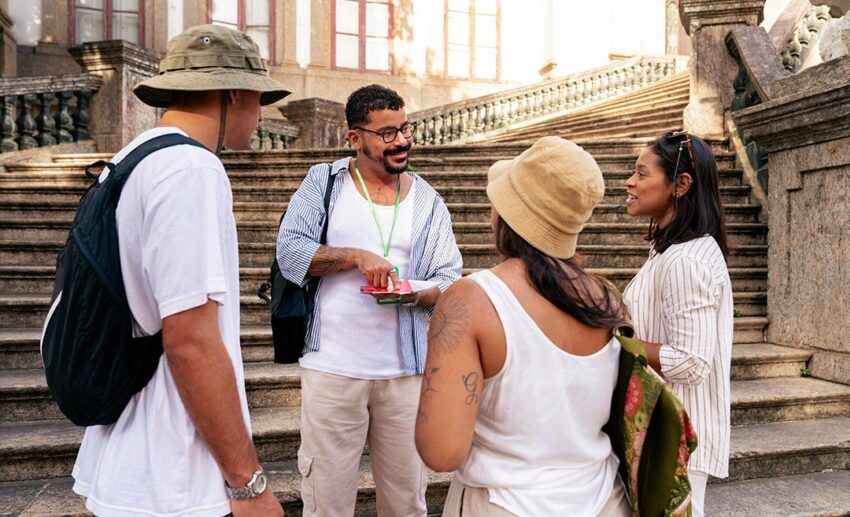
A practical guide to talking to strangers while travelling, without forcing yourself to become an extrovert. (Image by Elevate)
There is a particular kind of awkwardness that happens when you’re travelling and find yourself sitting beside a stranger. You’re both waiting for the same train. You are both clearly early for the walking tour. Maybe you’ve even made eye contact once or twice.
And yet, instead of saying hello, you suddenly become very interested in your phone.
I know this because I have done it. Many times.
Travel puts us in these situations constantly. We eat breakfast beside strangers, join group tours, share tables, sit next to people at bars, and find ourselves waiting for delayed trains with people we’ve never met. There are more natural opportunities to talk to strangers than we might have in our everyday lives. But for introverts, that first move can still feel surprisingly difficult.
The good news is that you don’t have to become an extrovert to get better at it. Sometimes, all it takes is making the first conversation a little easier.
The trick is not to turn every stranger into a new best friend. It’s simply to leave the door open for a conversation, a recommendation, a shared laugh, or a small moment of connection that makes a trip feel a little more human.
Start with a comment, not a question

“Where are you from?”
It’s probably the most obvious question to ask a stranger while travelling, which is precisely why it can feel like the conversational equivalent of walking into a wall.
Instead, try commenting on what’s happening around you first.
“That looks really good. What did you order?”
“Have you done this tour before?”
“I think we’re both completely lost.”
“Is this your first time here too?”
Notice that none of these require you to invent a conversation from thin air. You’re simply acknowledging something you already have in common.
I like to think of it as comment, then question. Make an observation, give the other person something to respond to, then see where it goes.
And if they don’t seem interested? That’s OK, too. You haven’t committed to a 45-minute conversation. You’ve just said hello.
Let your travel surroundings start the conversation

When you don’t know what to say, look up.
Travel destinations are basically conversation prompts waiting to happen. There’s the strange food someone is eating, the sudden downpour, the beautiful building across the street, the shop you’ve just discovered, the festival happening in the square, or the train that has apparently decided nobody has anywhere else to be.
Even someone’s book can be an opening.
“I’ve been meaning to read that.”
“What did you think of it?”
Sometimes we get so accustomed to filling every quiet moment with our phones that we forget there’s a world happening directly in front of us.
You don’t need to spend your entire holiday chatting to strangers. But putting your phone away for a few minutes can make you more aware of the small opportunities around you – and the people sharing them with you.
Choose experiences where conversation happens naturally

If the idea of walking up to a complete stranger and introducing yourself makes you want to disappear into the nearest bathroom, don’t do that.
Instead, change the circumstances.
Join a small-group walking tour. Sit at a communal table. Sign up for a cooking or craft class. Try a group hike, run club, or local workshop. Stay somewhere with shared spaces. Go to a small live music venue.
The point isn’t necessarily to make friends. It’s to put yourself somewhere conversation already has a reason to happen.
This takes some of the pressure off. If you’re both attending a cooking class, you already have something to talk about. If you’re on the same walking tour, you already have a shared experience. You don’t have to manufacture common ground because you’ve been handed some.
For an introvert, that’s a pretty good deal.
Ask questions that give a conversation somewhere to go
So you’ve made your opening comment. They’ve responded. Now comes the part many of us dread:
What do I say next?
Instead of firing off a series of interview questions, try asking things that invite a story.
Rather than, “How long are you here?”
Try, “What’s been your favourite thing you’ve done so far?”
Instead of, “Have you been here before?”
Try, “Is there somewhere you’ve been that you’d actually come back to?”
You can think of it as a simple conversation ladder: Observation → question → follow-up.
And the follow-up doesn’t have to be clever. If someone tells you they loved a particular neighbourhood, ask what they liked about it. If they mention a restaurant, ask what they ordered.
Good conversation isn’t necessarily about being fascinating. Sometimes, being curious is enough.
You don’t have to be interesting to connect with someone

I suspect this is where a lot of introvert anxiety actually comes from.
What if I say something stupid? What if there’s an awkward silence? What if I don’t know what to say next? What if they think I’m boring?
The truth is, you are probably giving this interaction far more weight than the other person is.
You’re not auditioning for a new best friend. You’re having a conversation with someone you might never see again.
You can listen. You can ask questions. You can admit that you’re terrible at small talk. You can even let the conversation fizzle out.
And perhaps that’s part of being willing to try something new: giving yourself permission to be bad at it first.
Not every interaction will be memorable. It doesn’t have to be.
Knowing how to leave makes starting easier

Here’s something that can make talking to strangers considerably less terrifying: knowing you can leave.
You are not trapped.
“It was lovely chatting with you. I’m going to grab some food.”
“I’m going to head off, but enjoy the rest of your evening!”
“I’m going to go explore that area before it gets dark.”
That’s it.
Knowing that you can politely end a conversation removes some of the pressure of starting one. You’re allowed to decide you’ve had enough.
And a successful conversation does not need to end with exchanging Instagram handles, making dinner plans, or promising to visit each other in six months.
Sometimes a 10-minute conversation is simply a 10-minute conversation.
Say yes sometimes, but keep your boundaries

Of course, you should still trust your instincts. You don’t have to accept every invitation from every stranger, and boundaries and safety matter, particularly when you’re travelling alone.
If you do decide to accept an invitation, you can still choose a public place, tell someone where you’re going, and leave if the situation stops feeling right.
But every now and then, perhaps say yes to something you would normally decline.
Someone from your walking tour asks if you’d like to grab a drink. Another traveller invites you to join their dinner. Someone recommends a neighbourhood you’ve never heard of and offers to show you around.
You don’t have to say yes to everything. Just consider saying yes occasionally to the things you would normally turn down because they’re unfamiliar.
That conversation might lead to a new friend. It might lead to dinner. It might lead to a recommendation you remember for years.
Or it might lead to absolutely nothing.
All of those outcomes are fine.
You don’t have to become a different person to meet people

Travel doesn’t have to turn an introvert into an extrovert.
You don’t need to come home with 17 new friends, exchange contact details with everyone you meet, or strike up a conversation with every person sitting beside you.
You just have to leave the door open a little.
Sometimes the stranger beside you will remain a stranger. Sometimes they’ll become your dinner companion for the evening, your hiking buddy, or someone you inexplicably bump into again three countries later.
And sometimes, talking to someone you’ve never met is simply a tiny act of courage – one more unfamiliar thing you were willing to try. You don’t have to travel differently to make those connections; you just have to be willing to look up, say hello, and see what happens.