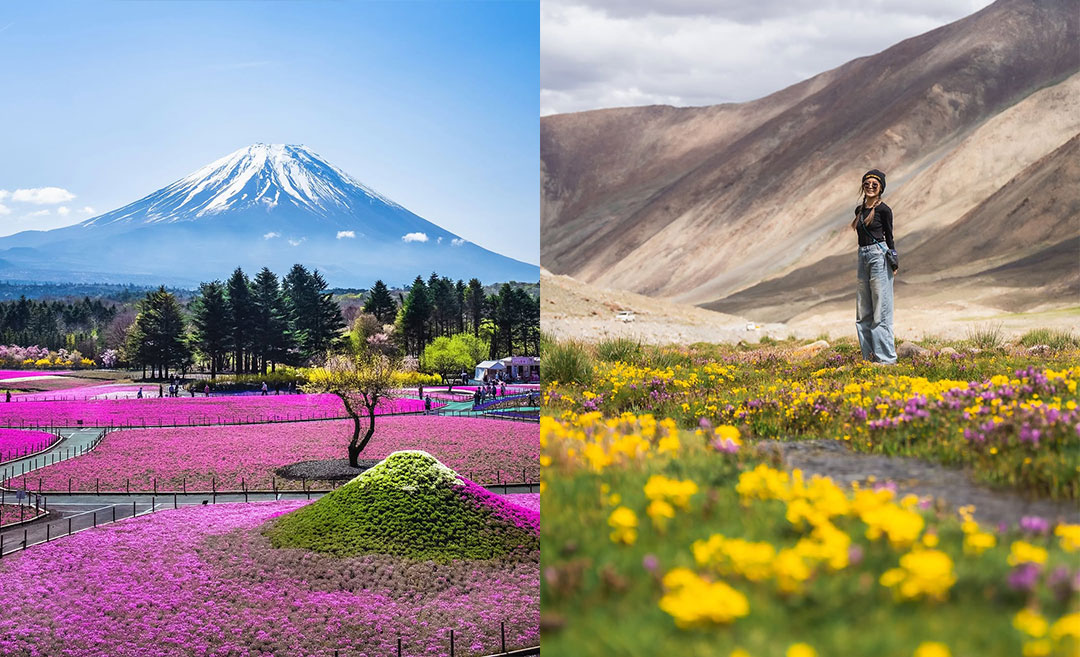
Spring in Asia is rarely a single moment; it is a progression that moves from the vivid pink moss carpets at the foot of Mt. Fuji to the high-altitude wildflower meadows of Ladakh. Whether in the shadow of a snowcapped peak or beside a quiet Himalayan stream, the season’s true beauty isn’t in the timing, but in the transition. (Left image by @visitjapan_uk. Right image by @eveif.eve.)
In Bangkok once, I went looking for sunflowers in a neighbourhood park I had read about somewhere. My sister trailed behind, patient as I scanned every corner, convinced they had to be there. We circled for close to an hour, pausing to ask locals, navigating a few lost-in-translation exchanges, until finally a park worker told us we had just missed them.
They weren’t in season anymore.
The disappointment came quickly, maybe a little sharper than it should have been. I had come with a specific image in mind, and the absence of it felt like a tiny failure. As we left, something else settled in. I realised I had spent the entire time looking for one thing, and in doing so, had overlooked everything else around me — the smaller flowers in bloom, the trees lining the paths, the way the park itself was quietly alive.
Cherry blossoms, in particular, have come to define what spring in Asia travel looks like. In Japan, bloom forecasts dictate flights, itineraries, and expectations. Sometimes entire trips are built around a narrow window of time, with the understanding that if you arrive too early or too late, you’ve somehow missed it.
There’s no denying their beauty, but there is also a certain urgency that surrounds them; a pressure to be there at the right moment to experience spring at its peak.
The question is what happens when we treat an entire season as a single point in time. Because across Asia, spring does not arrive all at once. It moves, and it shifts, and it looks different depending on where you are, and how long you’re willing to stay.
A spring unfolding across regions
Step beyond the usual, and spring begins to feel less like an event and more like a progression. The experience isn’t about catching a single bloom, but about witnessing how one gives way to another.
In Taiwan, the season stretches across landscapes rather than concentrating in one moment. Cherry blossoms appear first in mountain regions like Alishan, followed by tung flowers that blanket the ground in soft white, and later, calla lilies rising from cultivated fields.
South Korea offers a similar sense of movement. While Seoul’s cherry blossom season draws attention, other parts of the country unfold more gradually. On Jeju Island, canola flowers spread across open fields, marking the shift into warmer months, while inland regions hold onto blossoms slightly longer.
In China, spring often feels expansive. Rapeseed fields turn entire valleys yellow, while peach blossoms soften rural landscapes over days that shift almost imperceptibly. These are not isolated viewing spots, but environments shaped by the season itself.
Further south, northern Thailand’s cooler highlands bring a quieter bloom. Wild Himalayan cherry trees flower against misty backdrops, alongside orchids and other seasonal plants that appear without the same sense of spectacle.
In India, spring carries multiple expressions at once. Tulips bloom in Kashmir in carefully tended gardens, while rhododendrons appear across higher-altitude regions. In Karnataka, coffee blossoms arrive briefly, their scent marking the start of a new agricultural cycle before fading just as quickly.
Taken together, these places are not alternatives to cherry blossoms, but reminders that spring is not singular. It unfolds across time, geography, and context.
Staying for the season, not the moment
Travelling for blooms often means trying to get the timing right. Arrive too early, and nothing has opened. Arrive too late, and it’s already passed. Even at its peak, a bloom can change within days. Weather shifts. Petals fall. The experience is never fixed.
But not everything about travel needs to be precise.
What changes when you stay longer in one place is not just what you see, but how you see it. Instead of arriving for a single moment, you begin to notice the transitions — buds forming, flowers opening, colours fading, landscapes shifting.
What if you didn’t just visit a destination, but stayed long enough to watch it change? It might mean letting go of the idea of “perfect timing.” It might mean missing what you thought you came for.
On a later trip to Da Lat, I arrived just as the city was preparing for its biennial flower festival, and realised I would be leaving a day before it officially began. The timing felt almost ironic. But instead of trying to adjust plans or hold onto that sense of having missed something, I found myself moving through the city differently.
I paid attention to what was already there. Not the large displays being set up for the festival, but the smaller, quieter details: wildflowers pushing through cracks in the pavement, clusters of colour along the roadside, blooms that existed without announcement or crowd.
I still missed the festival, but this time, I didn’t leave with disappointment.
It wasn’t just a shift in perspective, but an internal recalibration of what I expected from the season itself.
Travelling for what doesn’t last
There is a certain tension in travelling for something that is by nature, temporary. Blooms arrive when they do. They stay briefly, then disappear. No amount of planning can fully guarantee that you will catch them at their peak.
But that uncertainty is part of the experience.
It asks for a different approach; one that allows for attention and a willingness to accept what is there, rather than what you expected to see.
In that Bangkok park, missing the sunflowers ended up revealing something else entirely. Not a single standout moment, but a broader awareness of everything that was already in front of me.
Spring, across Asia or anywhere else, offers that same possibility. Not something to chase or complete, but something to move through. Some seasons aren’t meant to be captured at their peak, but understood in the quiet moments we almost overlook.
The unhurried spring: A map of seasonal shifts
| REGION | (MARCH) THE EARLY AWAKENING | (APRIL) THE DEEPENING SEASON | (MAY) THE LATE SPRING SHIFT |
| VIETNAM | Coffee & Ban Flowers: Scented white coffee blooms in Da Lat; purple Bauhinia (Ban) in the northern hills. | Wild Sunflowers & Orchids: The highlands stay cool and misty, supporting shaded forest blooms. | Lush Rice Terraces: The bloom of the new planting season turns hillsides into reflective mirrors. |
| NORTHERN THAILAND | Thai Sakura: While the peak is February, high-altitude Wild Himalayan Cherries often linger into early March. | Orchids & Golden Showers: Thailand’s national flower (Ratchaphruek) bursts into bright yellow clusters. | Rainforest Canopy: The bloom shifts to the deep, vibrant greens of the pre-monsoon jungle. |
| JAPAN | Plum Blossoms (Ume): Fragrant, resilient blooms in Kyoto and Tokyo; a quieter precursor to the rush. | Pink Moss (Shibazakura): Vibrant pink carpets at the base of Mt. Fuji, offering a grounded perspective. | Wisteria & Nemophila: Hanging purple trellises and sea-blue hillsides as the season matures. |
| TAIWAN | Calla Lilies: The misty fields of Yangmingshan fill with elegant white blooms. | Tung Blossoms: April Snow blankets the forest floors in a soft, white layer. | Hydrangeas: Vibrant blue and purple clusters take over the mountain slopes. |
| SOUTH KOREA | Plum & Canola: Yellow waves on Jeju Island; delicate plum scents on the southern coast. | Azaleas & Tulips: Royal azaleas turn mountainsides pink; tiered tulip displays in city parks. | Greenery & Iris: Transitions to the lush, deep greens of tea plantations and forest irises. |
| INDIA | Red Rhododendrons: Brilliant crimson forests in the lower Himalayan foothills (Uttarakhand/Sikkim). | Kashmir Tulips: Asia’s largest tulip garden opens; higher altitude rhododendrons turn pink. | Alpine Wildflowers: As snow retreats, high-altitude meadows begin their multi-coloured carpets. |
Editor’s Note: Nature does not follow a calendar as strictly as we do. The windows above represent organic transitions influenced by altitude, rainfall, and microclimates. We encourage you to use this map not as a checklist but as a guide to the layered beauty waiting for you, regardless of exactly when you arrive.