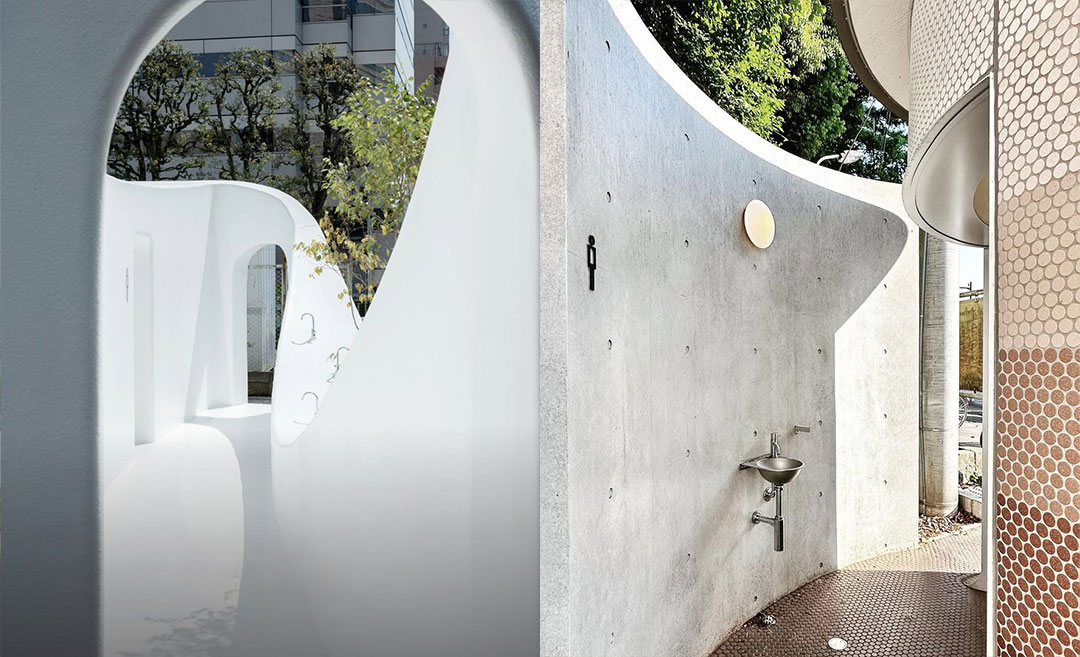
The Tokyo Toilet Project makes public toilets more than a shared common facility—they’re works of art that tell stories. (Left: Image courtesy of The Tokyo Toilet. Right: Image by @imansari.)
Public toilets are rarely things of beauty, much less stars in an Oscar-nominated film. The Tokyo Toilet Project—a collection of 17 public lavatories designed by renowned creators from Japan and beyond—aims to change that.
Artfully crafted yet fully functional, these commendable commodes were beautifully featured in Perfect Days, a Wim Wenders drama that follows the contented life of a janitor, Hirayama.
Whether you’re an art house lover, an architecture buff, or you simply need to answer the call of nature, these designer outhouses offer an off-the-beaten-path adventure.
Nishisando
📍 Location
Nearest station: Hatsudai Station (Keio Line)
Located on a sidewalk along the Asakusa Nishisando shopping street, this toilet by Hokkaido-born architect Sou Fujimoto plays with the concept of an ‘urban watering place’.
Flanked by arched doorways on opposite ends, the white-washed toilet features a roofless corridor lined with three gendered stalls. Five hand faucets are built into the sinuous structure at varying heights so both adults and children can easily use them.
Nabeshima Shoto Park
📍 Location
Nearest station: Shinsen Station (Keio Line)
Kengo Kuma, the architect behind the simple yet stunning Tokyo Olympics Stadium and Asakusa Culture Tourist Information Center, has crafted yet another understated gem.
The cluster of five lavatories is clad in cedar board louvres, with the naturalistic vibe continuing inside with wall decorations made of reused cherry and metasequoia wood.
The toilet, named ‘A Walk in the Woods’, is nestled within Nabeshima Shoto Park, just a stone’s throw away from the Shoto Museum of Art, one of Tokyo’s many cool art spaces.
Urasando
📍 Location
Nearest station: Kita-sando Station (Tokyo Metro Fukutoshin Line)
If you have Meiji Jingu on your itinerary, consider a pit stop at this toilet, tucked underneath a passageway right by the northeastern entrance to the Shinto shrine.
Equal parts cute and chic, the toilet features a sleek, copper Minoko roof often seen at shrines, temples, and tearooms—an homage to traditional Japanese architecture by Australian industrial designer Marc Newson.
Yoyogi-Hachiman
📍 Location
Nearest station: Yoyogi-koen Station (Tokyo Metro Chiyoda Line)
With its cylindrical shape and tiled gradient walls, the ‘Three Mushrooms’ toilet by Pritzker Prize-winner Toyo Ito looks like the setting for a Studio Ghibli movie.
Resembling giant toadstools, the toilet sits at the base of Yoyogi Hachimangu, a 13th-century Shinto shrine built on a hillock that was once the site of a Jomon settlement.
It is one of the iconic locations in Perfect Days, where Hirayama often enjoys a sandwich on his lunch break while photographing komorebi—sunlight filtering through the trees.
Yoyogi Fukamachi Mini Park
📍 Location
Nearest station: Yoyogi-koen Station (Tokyo Metro Chiyoda Line)
A transparent toilet seems all kinds of wrong, but Pritzker Prize-recipient Shigeru Ban has once again proven why he’s one of the most celebrated architects of his generation.
The glass walls allow users to check, from the outside, if the toilet is clean or whether anyone is inside. Thankfully, the glass turns opaque when the cubicle is locked, allowing for normal use.
This is one of two see-through toilet buildings designed by Ban for the Tokyo Toilet project. Its orange, pink, and purple hues are designed to match the colourful vibe of the adjacent children’s playground.
Haru-no-Ogawa Community Park
📍 Location
Nearest station: Yoyogi-koen Station (Tokyo Metro Chiyoda Line)
Shigeru Ban’s other toilet building, located just a short walk north, is similar in design and equally fun to use.
The toilet features cool shades of blue and green—a colour palette that complements the lush greenery of Yoyogi Park.
Jingu-dori Park
📍 Location
Nearest station: Shibuya Station (JR East Yamanote Line, Tokyo Metro Ginza Line, Keio Line)
Planning to visit the Hachiko Statue at Shibuya Station? Pencil in a stop at Jingu-dori Park.
Ensconced within cherry trees and flower beds, this toilet features a sleek exterior wall of vertical metal louvres, which conceals a curved passageway leading to the cubicles and sinks.
Named ‘Amayadori,’ which means to take shelter from the rain, this cylindrical stunner was designed by Pritzker Prize-winner Tadao Ando.
Jingumae
📍 Location
Nearest station: Meiji-jingumae ‘Harajuku’ Station (Tokyo Metro Chiyoda Line), Harajuku Station (JR East Yamanote Line)
Most tourists visit Harajuku for fashion and cosplay. But for true blue locals, like NIGO of A Bathing Ape, the area also has a history worth sharing.
Built in the style of a retro, Western-style house with mint green doors and red shingled roof, the fashion designer’s toilet revisits the look of Washington Heights, a postwar US Armed Forces housing complex that was demolished to make way for Yoyogi Park.
NIGO also designed the iconic blue boiler suit that Hariyama sported in Perfect Days.
Ebisu East Park
📍 Location
Nearest station: Ebisu Station (JR East Yamanote Line)
White walls, frosted glass, and a dramatic kinked roof make up this piece by the late Fumihiko Maki, a Pritzker Prize winner and one of the founding members of the Metabolism movement.
Known as the Squid Toilet, the facility sits within a children’s playground dubbed ‘Octopus Park’ for its giant red slide in the shape of the cephalopod.
Higashi Sanchome
📍 Location
Nearest station: Ebisu Station (JR East Yamanote Line)
It’s hard to miss this fire engine red toilet in Ebisu, a mecca of trendy izakaya and standing bars.
Inspired by origata, the Japanese art of gift-wrapping, New York-based product designer Nao Tamura crafted the triangular structure to resemble folds of paper.
Located right by a railway track, the angular toilet perfectly utilises an otherwise forgotten, narrow site.
Ebisu Station West Exit
📍 Location
Nearest station: Ebisu Station (JR East Yamanote Line)
Kashiwa Sato’s cube of white-washed aluminium louvres is a calm presence amid the throng of commuters who pass through Ebisu Station’s west exit.
Sato, the creative behind Yokohama’s Uniqlo Park and the Cup Noodles Museum, also designed the engraved nameplates spotted at all Tokyo Toilet locations.
Ebisu Park
📍 Location
Nearest station: Ebisu Station (JR East Yamanote Line)
Nestled within leafy Ebisu Park is a toilet whose cubicles are made up of a maze-like set of 15 concrete walls fitted with discreet vertical lighting.
Designed by Masamichi Katayama of interior design firm Wonderwall, it is a modernist take on the kawaya, primitive latrines built over the water along riverbanks.
Nanago Dori Park
📍 Location
Nearest station: Hatagaya Station (Keio Line)
‘Hi Toilet’ is both the name of this Kazoo Sato design as well as the voice command prompt for this high-tech toilet at Nanago Dori Park.
The fully voice-activated toilet responds to commands to close the door, turn on the tap, and even play music, a strategy aimed at minimising contact with surfaces.
Nishihara Itchome Park
📍 Location
Nearest station: Hatagaya Station (Keio Line)
This simple frosted glass block punctuated by bright green doors may look like any other public toilet, but come nighttime, you’ll notice why it’s called ‘Andon’, Japanese for ‘paper lantern’.
Designed by architect Takenosuke Sakakura, the facility gently glows after dark, illuminating its corner of Nishihara Itchome Park and making it that much more inviting.
Hatagaya
📍 Location
Nearest station: Sasazuka Station (Keio Line)
A public toilet or hip gathering place? Miles Pennington, a professor at the University of Tokyo and founder of DLX Design Lab, has envisioned a space that can be both.
Located on the corner of an intersection, the all-white toilet boasts an open foyer with spotlights and wooden benches that doubles as a space for the community to host talks, shows, pop-up markets, or even movie nights.
Sasazuka Greenway
📍 Location
Nearest station: Sasazuka Station (Keio Line)
Funky-looking with a hint of whimsy, these brown cylinders were designed by Junko Kobayashi of GONDOLA, the firm behind over 250 public toilets in the Japanese capital.
Situated under a railway track, this toilet seeks to emulate a stubborn but fun old man who is always watching over people. Standout features include a yellow, disc-shaped roof and small windows decorated with white rabbits.
Hiroo East Park
📍 Location
Nearest station: Hiro-o Station (Tokyo Metro Hibiya Line)
Creative director Tomohito Ushiro has created a minimalist structure with a concrete and steel finish, but its most striking feature is the rear wall, which features a large light panel.
The light panel, which glows green during the day and with firefly-like lighting at night, can create over 7.9 billion patterns—a number that represents the current world population and embodies the word ‘public’.
This one may be a little inconvenient for visitors to get to, as it is tucked within a residential area away from the tourist trail. But if you enjoy light shows, it’s worth dropping by Hiroo East Park to check it out.
This story by Irvin Hanni was originally published on AirAsia. Zafigo republished this story in full with permission from the publisher, simply because good stories should be read by as many people as possible! If you have stories that will be of interest and useful to women travellers, especially in Asia, please get in touch with us at [email protected].