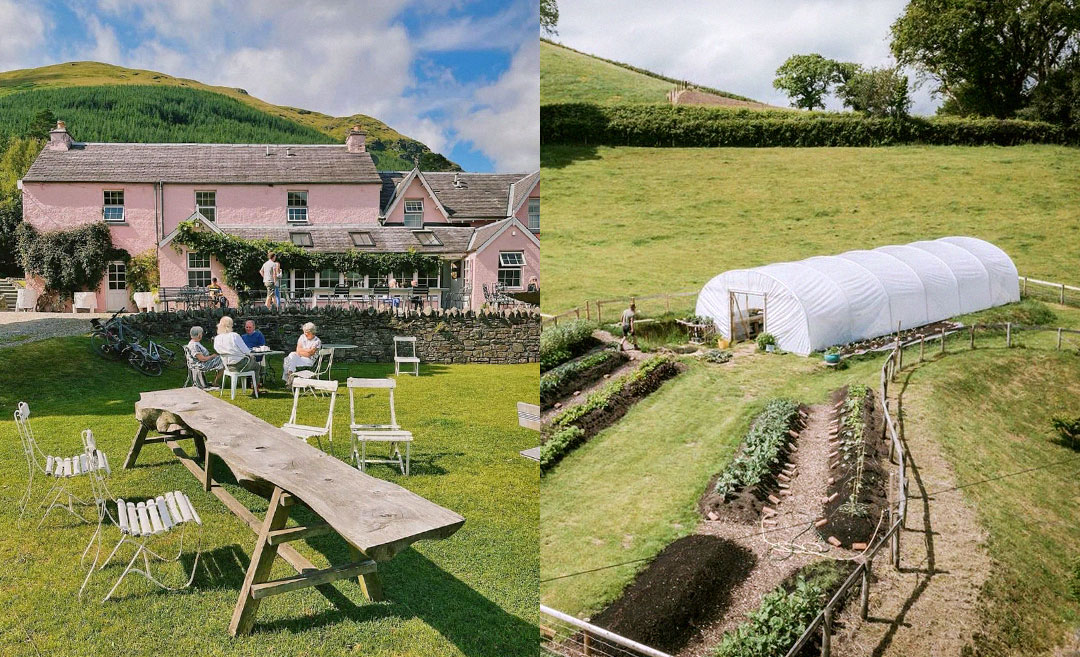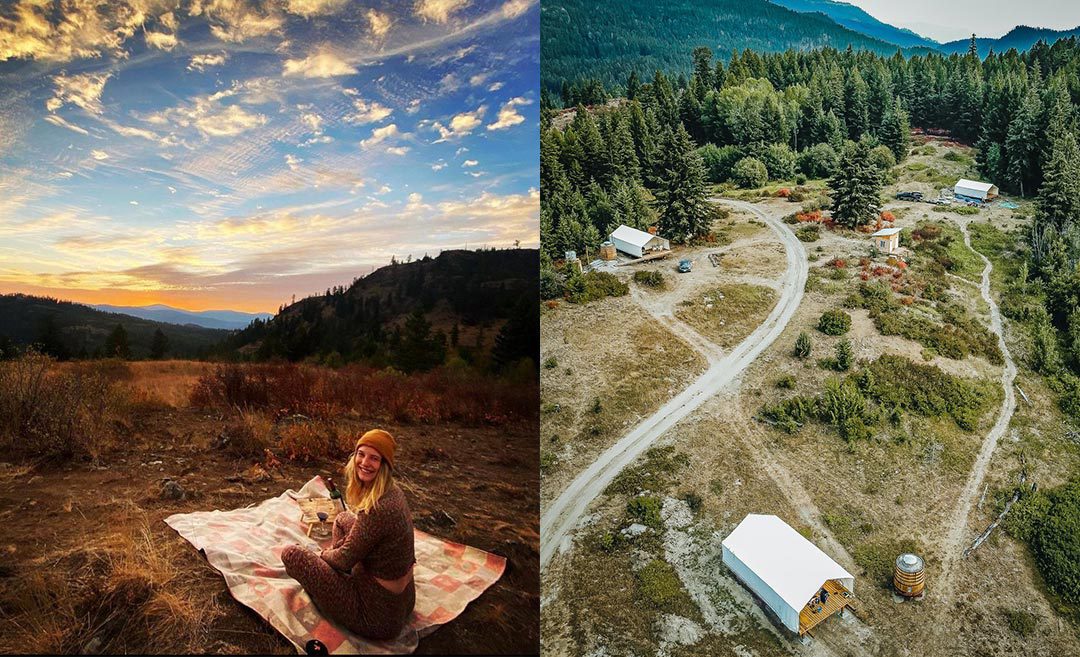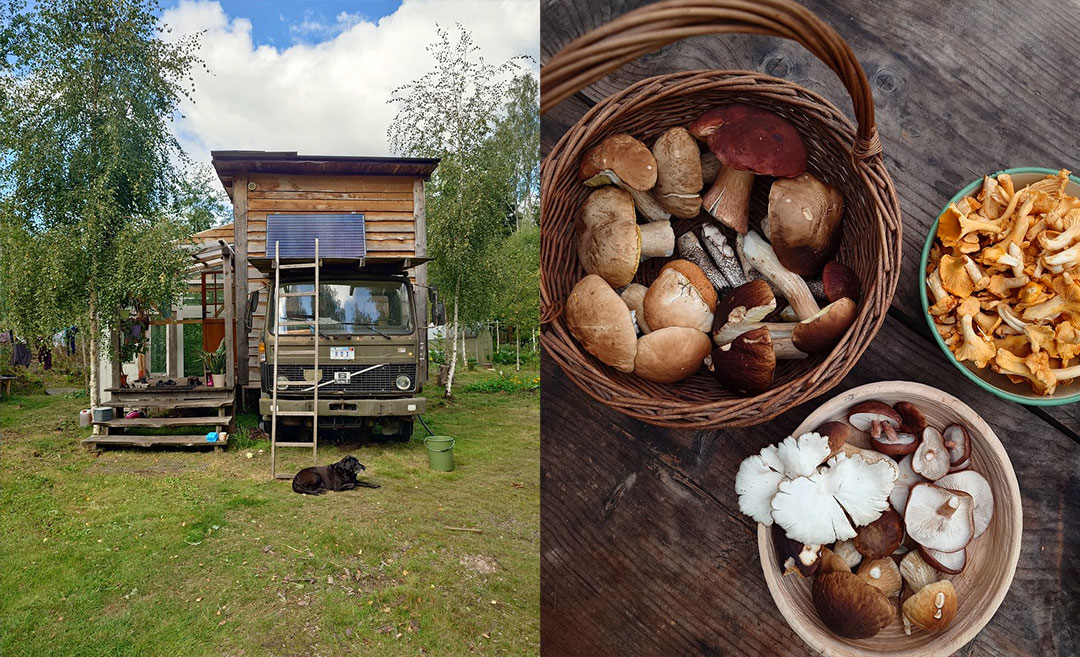
Two months of off-grid living at Humble Habitat taught me about making conscious choices and reconnecting with our resources, while still maintaining basic comforts. (Left and right images by Bianca Brand)
I spent two transformative months at Humble Habitat, a homestead in Central Sweden, where I discovered that sustainability doesn’t stop at sorting your recycling. It’s a daily practice that requires dedication, creativity, and occasionally, a good sense of humour.
From August’s overwhelming abundance to September and October’s winter prep, the homestead became my classroom in conscious living, complete with compost toilets, root cellars, and the sobering realisation of how carelessly I’ve been using water my whole life.
1. Master your relationship with water—yes, you’re definitely using too much

Nothing prepares you for the jarring truth that you’ve been wasting so. much. water. At Humble Habitat, every drop has a purpose—sometimes two. We’d use tubs to wash dishes, then collect dishwater in watering cans for the greenhouse.

The long, luxurious hot shower I loved? It became a distant memory, replaced by an ice-cold dip in the ‘beaver bucket’ (a little watering hole created by a beaver’s dam). The homestead’s greywater system opened my eyes to how water can work harder before it leaves your home.

Here’s how you can start using water smarter at home: start with a simple dishwashing basin system. Use hot water and biodegradable soap, rinse efficiently, and you’ve got nutrient-rich water your plants’ll love. After seeing how much you collect (even with conscious use), you develop a whole new respect for running a tap. I can’t run water mindlessly now without remembering the farmers walking back and forth to the greenhouse.
Check out our 101 on living sustainably in Kuala Lumpur here.
2. Solar power: Working around nature’s schedule

The Swedish autumn taught me that solar power isn’t the endless resource homesteaders make it seem. No sun? No kettle. Meaning we’d have to boil water on the stove, using gas—yet another limited resource. At Humble Habitat, we became energy opportunists, charging devices and battery packs during sunny spells, and scheduling energy-intensive tasks around weather forecasts. Otherwise, we’d have to face the head-splitting doom of the generator.
The adjustment was both practical and philosophical. You begin to understand electricity as something precious rather than infinite, flowing with nature’s rhythms rather than overusing resources just because they’re available around the clock.

To be more mindful of energy consumption at home, start by tracking your actual electricity consumption for a week. The phantom power from devices on standby might surprise you.
Learn how to conserve energy at home with these 10 small steps.
3. The art of preservation—because the future you depends on it


September transformed the outdoor kitchen into a factory of preservation. We sorted potatoes for the root cellar with the hyperfocus of surgeons, knowing one bad spud could spoil months of food. The process blended science with generational wisdom—learning which vegetables store well in the cellar, determining what to pickle versus what to dry, and understanding why meticulous prep can make or break your winter meals.


The wood-fired clay oven, built on-site with local materials, became our jarring workhorse. We dried sanitised (boiled) jars by the dozens, then jarred (among other things) stewed tomatoes, chutney, and my personal favourite…honey.

There’s something deeply satisfying about transforming autumn’s overwhelming cucumber, carrot, beetroot, and red cabbage harvest into pickles that’ll brighten mid-winter meals.


Late summer and autumn are also the seasons for wild blueberries, cranberries, and mushrooms, which we cleaned and dried with a dehydrator. Beyond that, preservation reconnects you to generations who understood that summer’s abundance must sustain winter’s scarcity. It’s meditative work that grounds you in a seasonal routine that on-grid living has disconnected us from.
Plus, preserving food means less goes to waste—and it’s good for your gut health.
4. Compost toilets: More civilised than you think

Let’s talk about the compost toilet. It’s really not the dramatic adjustment you might imagine. Humble Habitat’s system is straightforward: use it, add a scoop or two of sawdust, and occasionally empty it into a larger compost system where it eventually becomes garden gold. To make the transfer to the larger compost a more pleasant experience, it is recommended to use the compost toilet exclusively for #2s. There’s less… splatter. Flash nature for #1s.

Once you understand that ‘waste’ is just another resource in nature’s cycle, the whole thing makes perfect sense. Nature thrives on this closed-loop system. It’s humbling and empowering to realise how simple solutions can address complex environmental problems. Plus, there’s something oddly satisfying in knowing that my poo contributes to tree growth in such a direct way.
5. Local everything: Tread lightly, smaller footprint

When Humble Habitat needed something it couldn’t produce, the solution was always: prioritise local. This meant developing relationships with neighbours, discovering that Karl’s horse manure from down the road is going to fertilise the garden in a much better way than chemicals, and learning that community connections create resilience no corporation can match.


But here’s a truth nugget: growing your own food is hard work with no guarantees. Caterpillars decimated the kale, voles found the root veggies particularly delectable, and late blight claimed half the potatoes and tomatoes. Photo-perfect veggies? Ours looked comedically special.


Yet when all meals consist of homegrown and homemade everything—fresh herbs, and eggs straight from the mothercluckin’ coop—the satisfaction (and taste) is incomparable. It takes serious labour, time, planning, and acceptance that nature doesn’t always cooperate with your meal plans.
At home, if you don’t have the space or time to grow your own food, then buying local produce is a great place to start. Curious to know how good local produce tastes? Here are farm restaurants in Malaysia offering the true farm-to-table experience.
The takeaway

Two months of partial off-grid living taught me that it’s equal parts rewarding and challenging. Every meal involves multiple steps that most of us have forgotten exist. Every resource demands consciousness and respect. But what surprised me most was that it’s not about completely disconnecting from modern life. It’s about choosing your connections wisely and understanding the true cost of convenience.

Humble Habitat demonstrated that working toward off-grid living is accessible and adaptable. Once you start seeing the impact of small, intentional choices, it becomes genuinely addictive. The Swedish homestead didn’t make me want to abandon modern life. It made me more grateful and want to tread more thoughtfully.

Learn more about Humble Habitat below: