Discover Malaysia’s traditional crafts — from songket to sign painting — and the makers preserving heritage skills. (Left image by @zeharn_zeherng. Right image by @tanoticrafts.)
You don’t simply stumble upon traditional crafts by accident. You find them when you slow down and when you linger in towns longer than planned, or when you scrap the Google Maps saved list, and follow the sights and sounds instead.
Before Malaysia’s towns were reshaped by highways and cafes, they were defined by craft. Entire communities grew around weaving, silversmithing, wood carving, and painting. Skills were learned at home over time and passed down quietly through generations.
Today, many of these heritage crafts sit on the edge of disappearance — not because they lack value, but because modern life rarely allows for slowness. Everything moves faster, and fewer people have the time or patience to learn intricate, time-intensive skills. Yet despite technological progress, these crafts have not vanished. They are still here, kept alive by dedicated makers, waiting for travellers and locals willing to look a little harder.
Terengganu: Songket weavers keeping tradition alive
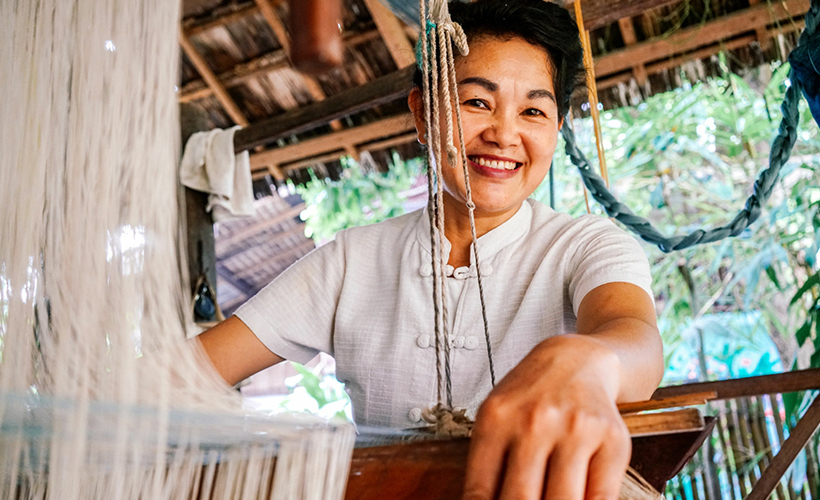
In Terengganu, songket is something you hear before you see. The steady clack of a wooden loom drifting from kampung houses in villages like Losong and Chendering. It’s quieter than it used to be, but it’s still there if you stop and listen.
Songket weaving (tenunan songket) was traditionally done by women, fitted around daily life. Gold and silver threads are woven into silk or cotton, forming motifs inspired by nature, belief, and discipline. Each pattern follows strict rules, and even small mistakes are visible. Depending on the design, a single piece can take weeks, sometimes months, to complete.
Machine-made songket is faster and cheaper, but it lacks the depth and weight of something made slowly by hand. To adapt, many weavers now create scarves, contemporary pieces and home accents alongside ceremonial kain (cloth).
Spend time beside a weaver, and it becomes clear that songket is more than fabric. It’s patience, muscle memory and a way of life that moves at its own pace. Master Artisans like Che Rohani, and younger generation weavers like sisters Sukma (Tania) and Ramlah Kipli keep the craft alive, producing Royal Terengganu Songket using menyongket techniques that can take up to two or three months to complete a single sarong.
Kelantan: The silversmiths preserving royal craft
Silverwork (pertukangan perak) has long been part of Kelantan’s identity. Much of it was once made for the court: ceremonial objects, jewellery, and pieces designed to last. Designs were memorised rather than drawn, with skills passed down through years of observation, repetition, and mentorship.
The work demands total focus. There are no shortcuts, and little room for error. Today, many master silversmiths are ageing, with few apprentices willing to commit to a craft that offers slow returns in a fast, convenience-driven market. Imported jewellery has also shifted expectations around price and speed.
Still, some workshops remain open. While craftsmen such as Pok Wi carry the technical legacy, much of the craft’s continuity today depends on artisanal brands like Senijari to keep traditional silverwork alive by curating contemporary jewellery that preserves classic awan larat and floral motifs for modern wearers.
Sarawak: Beadmakers safeguarding cultural identity
Among Orang Ulu, Iban, and Bidayuh communities in Sarawak, beadwork—known locally as seni manik—has long been a way of expressing identity, status, and belief. Every detail matters, from colour choices to patterns and arrangement.
The knowledge isn’t written down. It’s carried through people. Learning beadmaking means listening to elders and understanding the stories behind each design. As younger generations move away from rural areas, what’s at risk isn’t just the skill, but the meaning attached to it.
To keep the craft going, some artisans now teach workshops, document traditional patterns or adapt beadwork for contemporary use. Skilled artisans like Juliana anak Embrose (juliana_nativehandwork), and Litad Muluk and her daughter Patricia (from Kampung Long Tuma) remain among the few who still make ceramic beads from scratch, resisting the rise of plastic imports. Meanwhile, younger makers like Renieda Sigang Ronnie (of nidmadetings) are reinterpreting Orang Ulu bead designs for everyday wear.
Penang: The last traditional sign painters
Penang is known for its food, and for good reason. George Town is packed with stalls, cafes and restaurants. But when you’re there, it’s worth slowing down—and looking up.
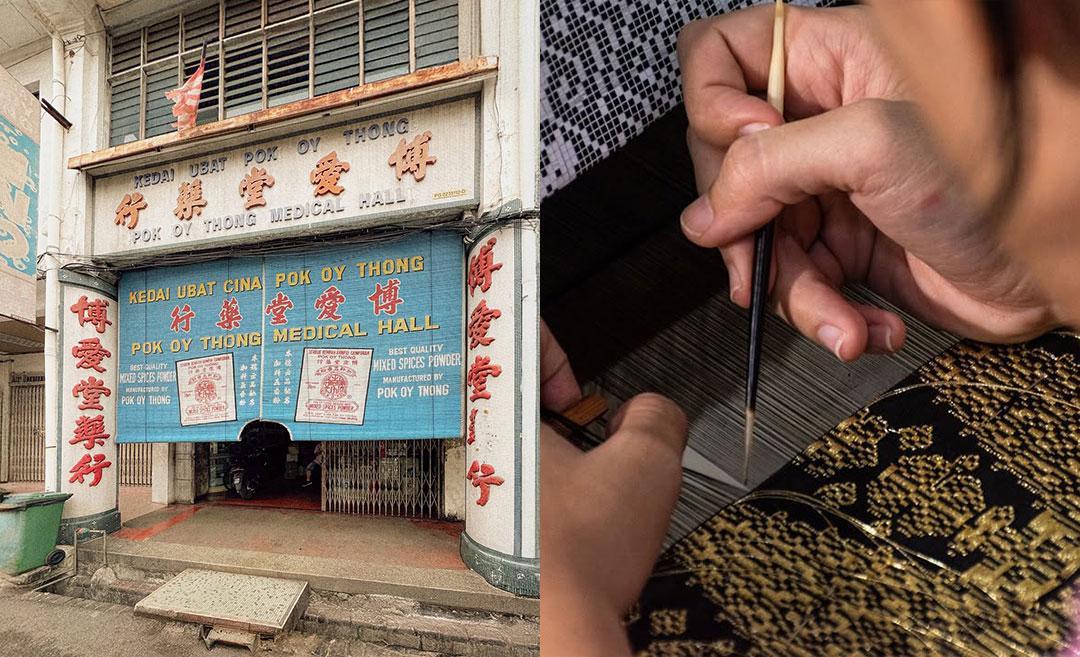
Old shop signs still hang above doorways: hand-painted, slightly faded, full of character. Before vinyl banners and LED lights, sign painting (seni lukisan papan tanda) was a respected trade. Each sign was custom-made, with letters painted freehand and styles that reflected the time and place they belonged to.
Today, only a handful of traditional sign painters remain. Most learned the craft young, mixing paints by instinct and working without stencils or guides.
Some now collaborate with cafes and heritage projects. Others simply continue, even as demand shrinks. While master sign painters like Kok Ah Wah represent an older generation, contemporary artists are helping preserve traditional typography. These signs remain part of George Town’s visual history, and once they disappear, they don’t come back.
Melaka: The wood carvers preserving handcrafted heritage
In Melaka, traditional wood carving (ukiran kayu) is easy to overlook. It shows up quietly above doorways, along ventilation panels, and around windows. The patterns weren’t just decorative; they helped cool homes and reflected the beliefs of the people who lived in them.
Carvers once worked closely with builders, shaping houses with intention. Today, most modern buildings leave no room for this kind of detail, and the number of skilled carvers has dropped sharply.
While galleries like Fwu Chang continue preserving traditional carving, the people of villages like Kampung Morten also play a quiet but vital role — safeguarding finishing techniques, polishing methods and the storytelling behind floral motifs. At places like Villa Sentosa, both male and female descendants now serve as living custodians of Melaka’s carved architectural heritage.
Once you notice these details, it’s hard not to see how much of the town was shaped by hand.
More than just objects, these crafts are stories shaped by time and patience, kept alive by people who believe some things are worth preserving, no matter how long they take.
Zafigo Tips: A responsible traveller’s guide to buying
Choosing to bring home a piece of heritage is a powerful act of support for the women and communities preserving these skills. However, in a market flooded with mass-produced imitations, being a responsible traveller means shopping with intention:
Check the reverse side: For songket, look for loose threads on the back; this proves it was hand-woven on a loom rather than printed by a machine.
The “weight” test: Handmade silver and beadwork feel substantial. If a piece feels overly light or “plastic-y,” it likely lacks the density of traditional craftsmanship.
Ask for the maker’s story: If a seller can’t tell you the village or the maker who crafted the item, it may be a mass-produced import.
Value the “slow”: A hand-stamped batik or woven sarong takes weeks to finish. Respect the price tag—fair pay ensures these heritage skills don’t disappear.
Look for certifications: When in doubt, buy from established social enterprises like Tanoti (Sarawak), Senijari (Heritage Jewellery), or Batik Boutique (Kuala Lumpur).